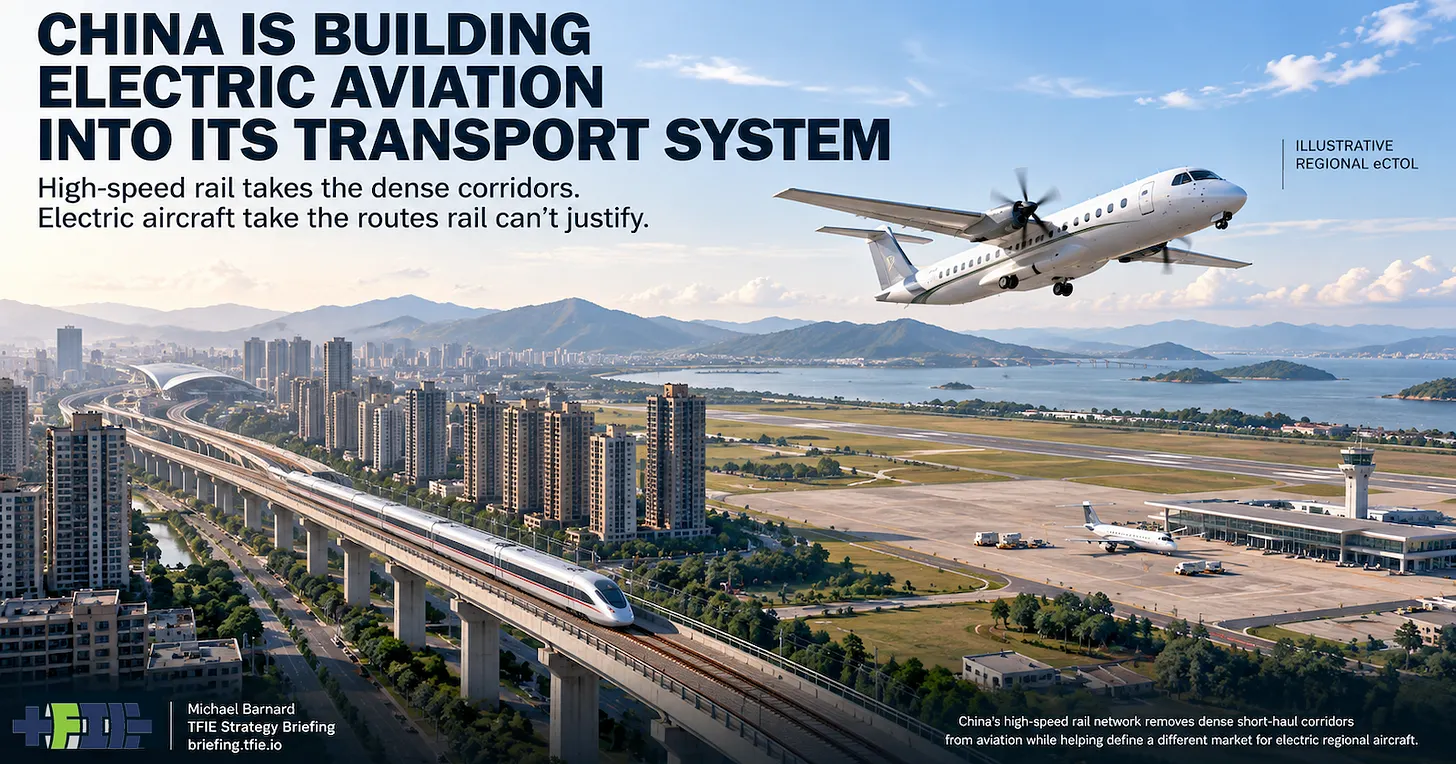
China is developing an electric aviation industry by integrating aircraft into a broader transport system rather than focusing solely on prototypes. The country leverages its extensive high-speed rail network, which reached 50,400 kilometers by the end of 2025 and is projected to reach 60,000 kilometers by 2030, to handle dense city routes, leaving regional and cargo gaps for electric aircraft.
The nation's industrial advantage lies in its battery manufacturing capacity, as it produced over 80% of global battery cells in 2025. Companies like CATL are developing aviation-specific cells, including a condensed cell reaching 500 Wh/kg, while focusing on safety testing and system integration. State-backed entities like COMAC and AECC are also working on electric and hybrid propulsion systems.
Regulatory and policy frameworks are central to this strategy. The Green Aviation Manufacturing Development Outline for 2023–2035 and the CAAC operating framework address infrastructure, charging, and maintenance. These efforts aim to move beyond demonstration flights toward a model where hundreds of aircraft operate on regular schedules, supported by established maintenance and training.
China aims to export this integrated model, similar to its approach with the C909 aircraft, which began commercial operations in Southeast Asia by early 2026. Success will be measured by the accumulation of flight hours, battery replacement cycles, and repeat orders. While Western competitors like Heart Aerospace have achieved flight milestones, China focuses on building a scalable deployment system.