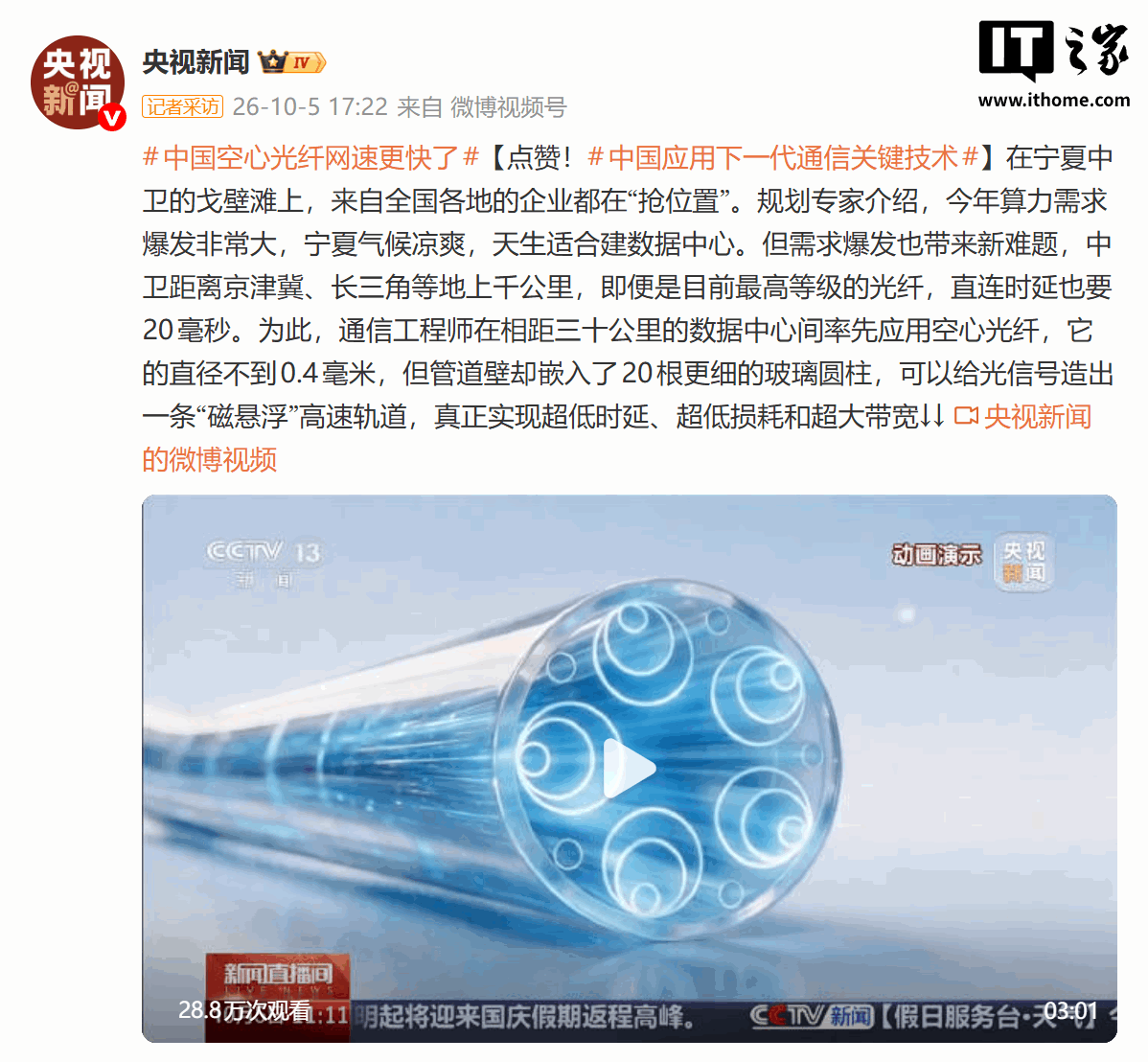
China has officially deployed hollow-core fiber optic technology for commercial use between data centers in Zhongwei, Ningxia. This implementation aims to optimize data transmission for AI computing clusters by significantly reducing latency and signal loss.
The new fiber optic infrastructure features a diameter of less than 0.4 millimeters and contains 20 micro-glass cylinders. By replacing the solid glass core with an air-filled channel, the technology allows light signals to travel at 99.7 percent of the speed of light, compared to the 69.5 percent limit of traditional fiber.
Engineers completed the first large-scale deployment covering a 30-kilometer distance between data centers. This project addresses the high latency issues previously encountered when connecting remote computing hubs to major demand centers like the Beijing-Tianjin-Hebei region.
The application of this technology results in a reduction of transmission latency and signal loss by more than 30 percent. This advancement is intended to support next-generation communication networks by providing high-bandwidth and low-latency connectivity for cross-regional computing tasks.