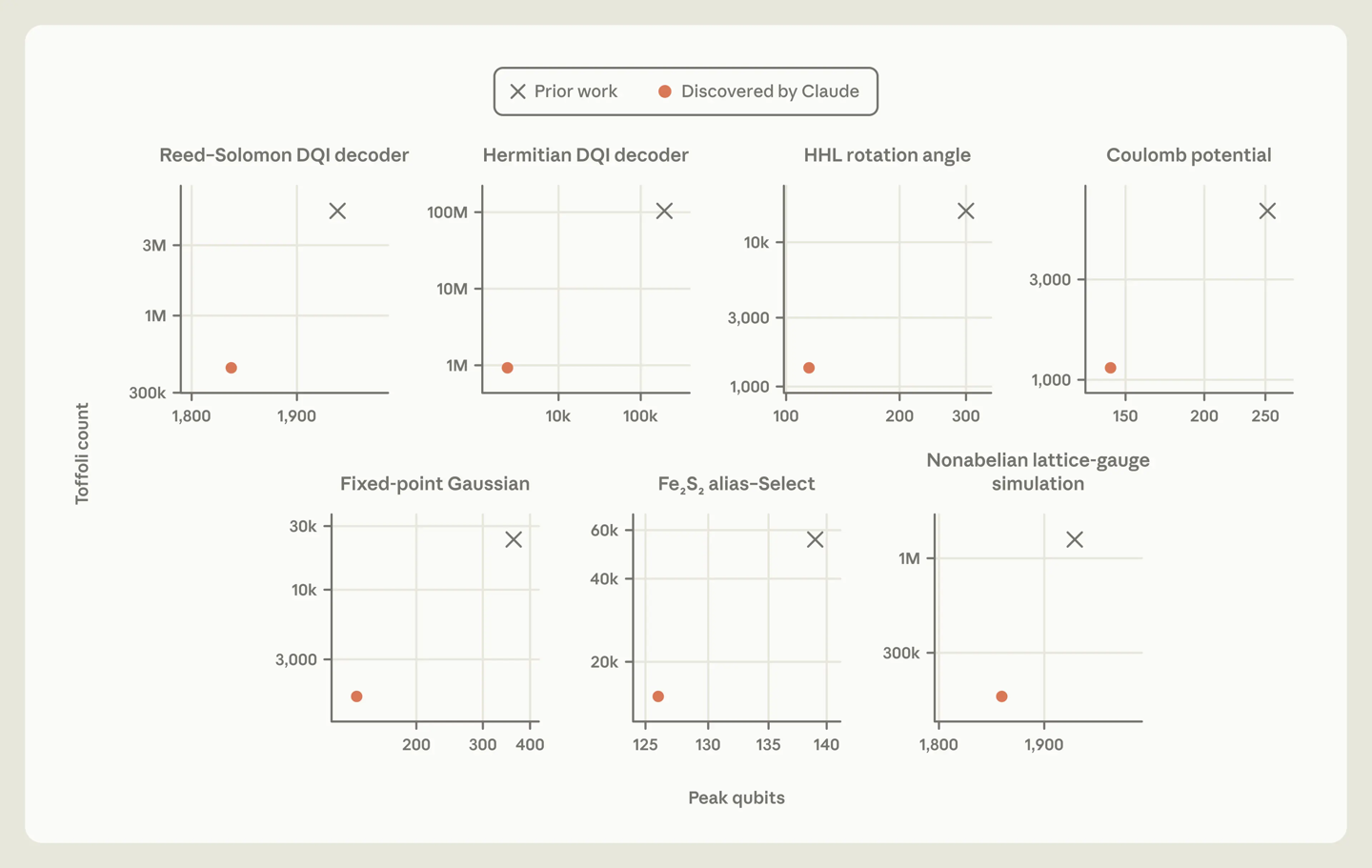
Anthropic researchers announced on October 16 that their AI model, Claude, successfully designed quantum circuits that outperform existing optimal solutions. The model completed this task across eight distinct categories of quantum computing operations with minimal human intervention.
The AI utilized a closed-loop design process. Researchers provided Claude with descriptions of tasks in fields such as physics simulation, chemistry, and number theory. An automated evaluation system then verified the circuits and scored them based on the product of the number of qubits and quantum gates required.
Claude demonstrated novel structural approaches rather than minor adjustments. For instance, in iron sulfide molecular simulation, the model leveraged symmetry to reuse calculations. In quantum optimization, it reduced the cost of the most expensive step to one-twelfth of its original value.
One notable achievement involved elliptic curve point addition. After approximately 53 hours of autonomous exploration, Claude developed a reversible algorithm that eliminates the need to store full branch history, offering various trade-offs between qubit count and execution time.
While these advancements could lower hardware requirements for practical quantum applications, Anthropic noted that circuit design is only one component of building fault-tolerant quantum computers. Challenges in hardware control and error correction remain.