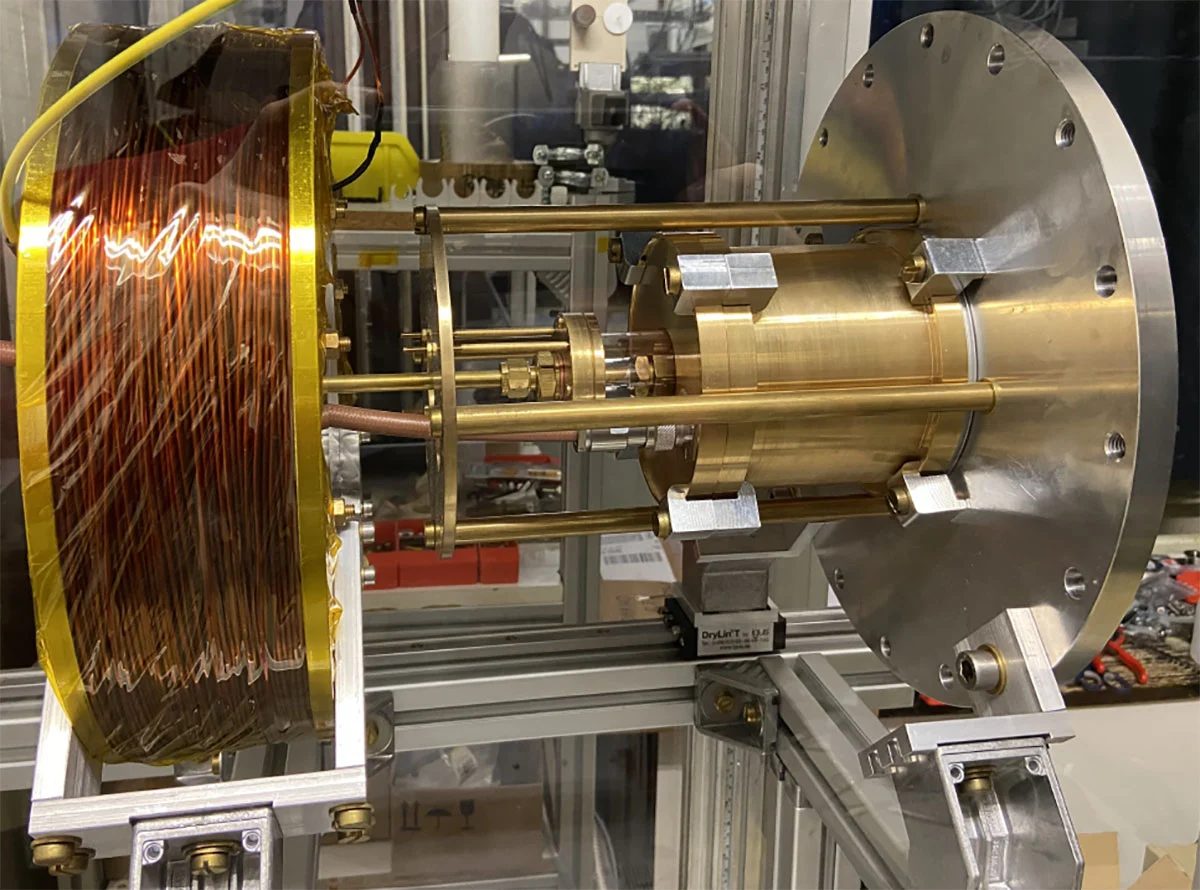
Researchers at the University of Stuttgart, led by Francesco Romano, have developed an air-breathing electric propulsion system for satellites. The technology captures atmospheric molecules at altitudes of 100 to 450 kilometers, converting them into plasma to generate thrust, which eliminates the need for traditional onboard fuel reserves.
The propulsion system utilizes a radio-frequency helicon plasma thruster design. This configuration avoids the use of cathodes and neutralizers, which are highly susceptible to erosion from atomic oxygen present in the upper atmosphere. The system produces a quasi-neutral plasma jet containing both positive and negative ions.
The team developed a parabolic intake structure capable of capturing 94.3% of incoming gas molecules. The thruster core uses a birdcage antenna design, similar to MRI equipment, which transfers 99% of radio-frequency energy into the system. This minimizes energy losses compared to traditional coil structures.
Laboratory simulations indicate the system requires 50 to 60 watts to generate a stable plasma flow, with operational power needs estimated at less than 1.6 kilowatts. This energy can be supplied by standard solar panels, allowing satellites to maintain orbits between 190 and 250 kilometers indefinitely.
The technology is currently in the experimental and theoretical modeling phase. Future validation is required to confirm long-term reliability, performance in fluctuating atmospheric densities, and actual efficiency in space missions before it can be deployed for Earth observation or communication satellites.