

Astronomers used the XRISM X-ray observatory to observe the BP Crucis system, located 13,000 light-years from Earth. The system consists of the pulsar GX 301-2 and its companion, the blue hypergiant Wray 977. Wray 977 has a mass of about 40 Suns and a diameter 60 times that of the Sun, while the neutron star GX 301-2 has a mass exceeding the Sun and a diameter of 20 kilometers.
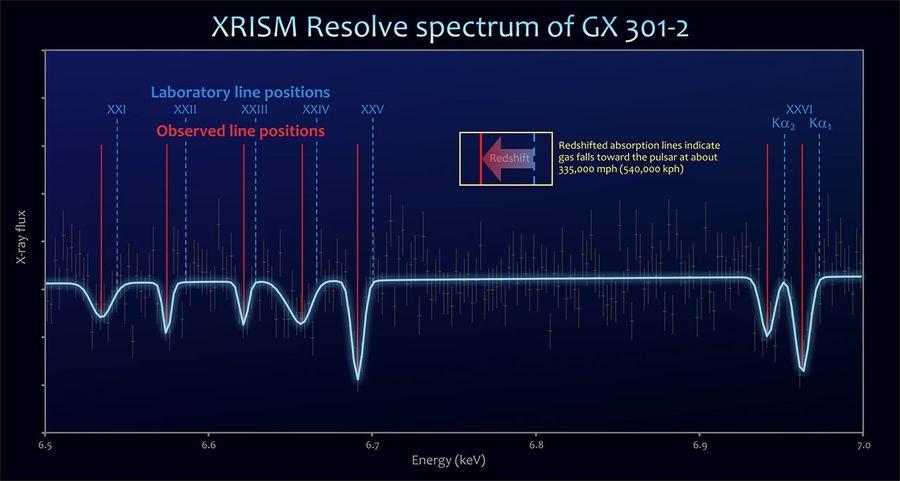
The pulsar completes a rotation every 11 minutes and orbits its companion every 41.5 days. During these orbits, the system experiences X-ray flares when the pulsar passes through dense streams of stellar wind. On February 1, 2025, XRISM monitored the system for 16 hours during a flare event, using the Resolve spectrometer to detect redshifted absorption lines of highly ionized iron.
The data indicated that plasma moves toward the pulsar at a speed of 540,000 km/h. Scientists suggest that captured gas forms a turbulent disk around the pulsar, which heats up and emits X-rays. As the pulsar moves through the stream, the disk collapses, allowing plasma to fall directly onto the neutron star. The entire transition through the dense flow lasts approximately 4 days.



