

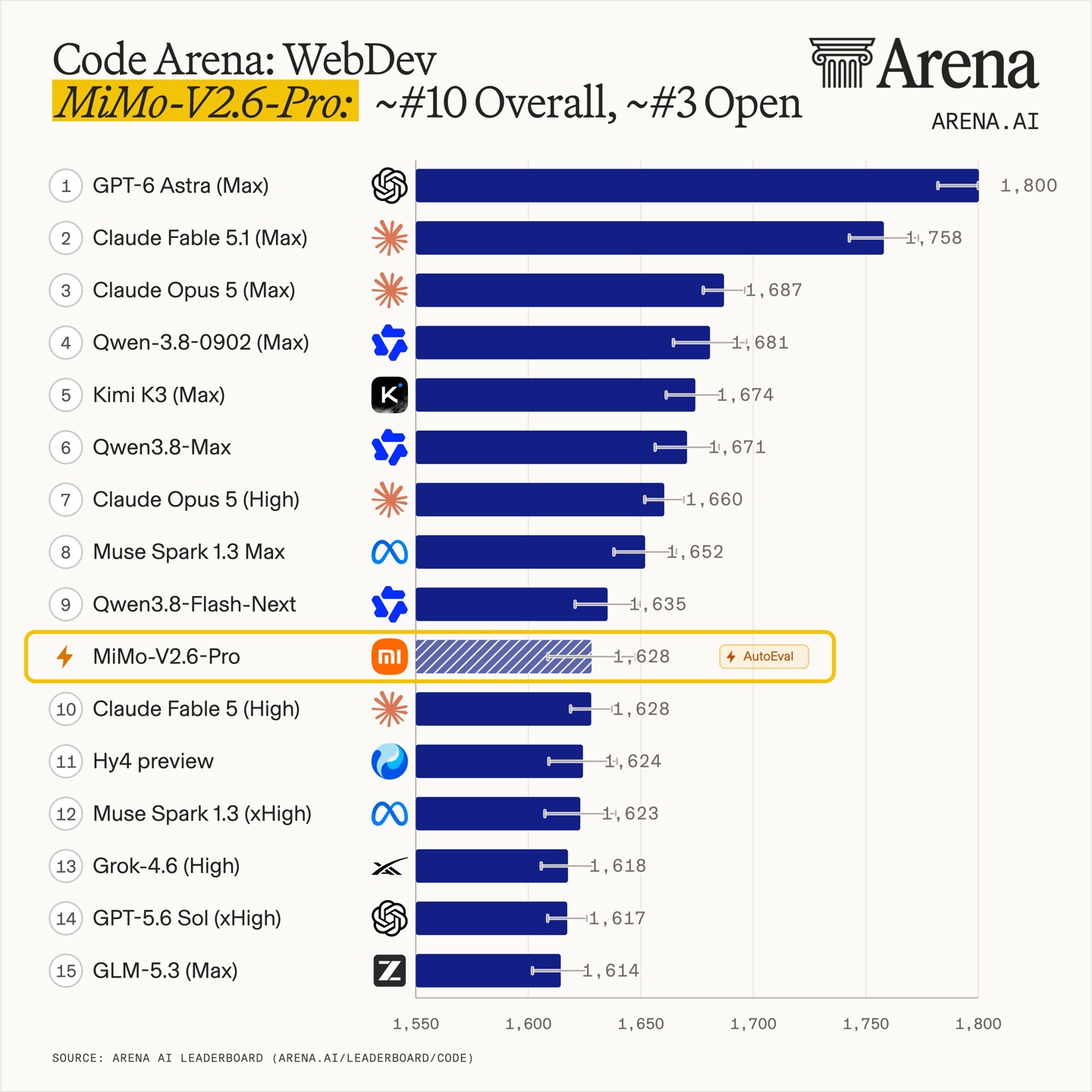
Xiaomi has officially released and open-sourced the MiMo-V2.6 series, featuring two native multimodal models: Pro and Flash. The company utilizes a Recursive Self-Improvement (RSI) path to scale reinforcement learning compute and expand the intelligence capabilities of these models.
The MiMo-V2.6-Pro model is now being deployed for scientific research, specifically in metal-organic framework (MOF) material design. By assisting with literature reviews, hypothesis generation, and simulation analysis, the model reduced the research cycle for PFAS adsorption from one month to 2–3 days, marking a 10-fold increase in efficiency.
In the field of mathematics, the model successfully completed the formal proof of the Li–Yorke theorem in Lean 4. The process involved generating over 6,000 lines of source code that passed kernel verification, despite the model not receiving specific post-training for the Lean environment.
Pricing for the MiMo-V2.6 series remains consistent with the V2.5 series. The Flash version costs ¥1 per million input tokens and ¥2 per million output tokens, while the Pro version is priced at ¥3 and ¥6 respectively. Xiaomi offers a 99% cache discount and claims the pricing is 1/20 to 1/60 of comparable overseas models.



