

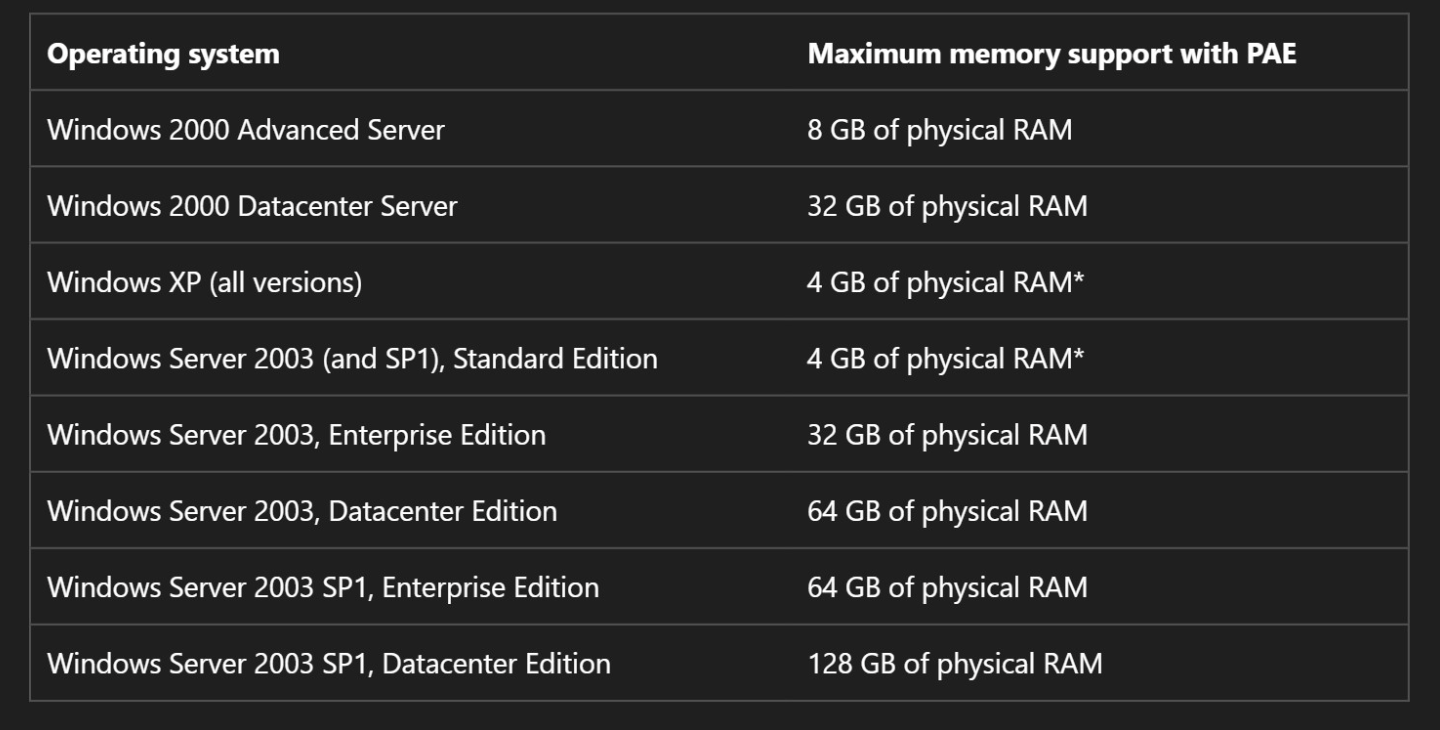
Many users believed that 32-bit Windows systems were limited to 4GB of RAM due to address space constraints. However, Microsoft previously implemented Physical Address Extension (PAE) technology, which allowed 32-bit processors to access more than 4GB of physical memory by using 36-bit addresses.
Microsoft restricted this capability in consumer versions of Windows to prevent system crashes. The company was concerned that third-party hardware drivers, which were not designed to handle addresses exceeding 32 bits, would cause memory corruption or system instability when accessing higher memory ranges.
In Windows XP SP2 and Windows Server 2003 SP1 Standard Edition, Microsoft limited the physical address space to 4GB to mitigate risks from untested drivers. In contrast, server versions like Windows Server 2003 SP1 Enterprise supported up to 64GB, and the Datacenter version supported up to 128GB.
The company denied claims that the 4GB limit was a strategy to force users to purchase expensive server software. For instance, the Enterprise version of Windows Server 2003 was priced at $3,999. Eventually, the industry transitioned to 64-bit architectures, rendering the 32-bit memory limitation obsolete.



