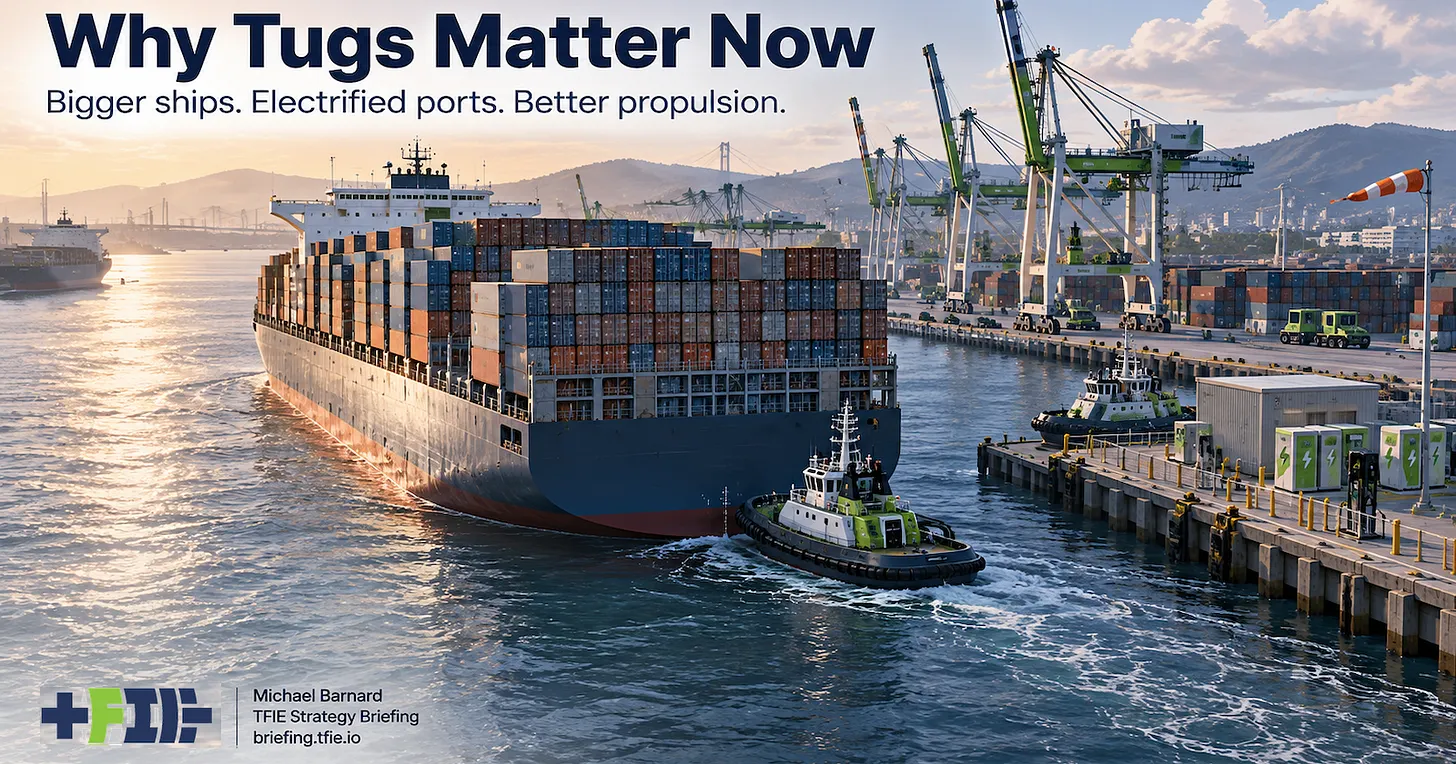
Harbour tugs require high instantaneous power for short durations, which makes them suitable for battery propulsion despite their high nominal power ratings. Unlike deep-sea vessels, tugs operate with variable loads and spend significant time waiting or moving at low speeds, allowing battery systems to handle peak demands efficiently.
New vessel designs, such as the TRAnsverse tugs from Svitzer and Robert Allan, improve operational efficiency by optimizing propulsion geometry. By reducing the energy spent on repositioning the tug, these designs lower the overall power requirements, making battery-electric configurations more viable for port operations.
Port infrastructure is increasingly capable of supporting electric vessels due to the existing deployment of electric cranes and shore power systems. Vancouver currently operates two battery-electric ElectRA tugs, demonstrating the practical application of this technology in real-world harbour environments.
While battery-electric vessels currently represent less than 1% of the global fleet of approximately 23 500 registered tugs, the order pipeline is growing. Svitzer is constructing four battery-electric TRAnsverse tugs, and Curtin Maritime has ordered eight large-battery hybrid-electric vessels.