

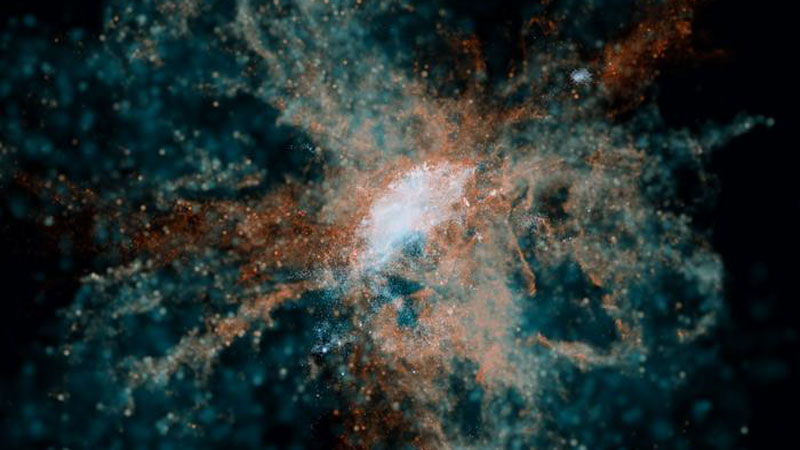
Researchers from the University of Arizona analyzed data collected by the James Webb Space Telescope during a 30-hour observation session. They identified three galaxies existing approximately 500 million years after the Big Bang, corresponding to a redshift of z = 7.2–9.3.
Spectroscopic analysis using the NIRSpec instrument revealed the presence of oxygen, carbon, and silicon in the gas surrounding these galaxies. The absorption lines showed that this enriched gas was moving outward from the galaxies at velocities ranging from 50 to 250 km/s.
The findings indicate that a baryon cycle, involving the exchange of matter between galaxies and their environment, was already active in the early universe. Massive stars synthesized heavy elements and expelled them via stellar winds and supernova explosions.
The chemical composition of these early galaxies resembles that of more mature systems, suggesting a rapid evolution of matter circulation. This discovery complicates the search for Population III stars, which were expected to consist primarily of primordial hydrogen and helium.



