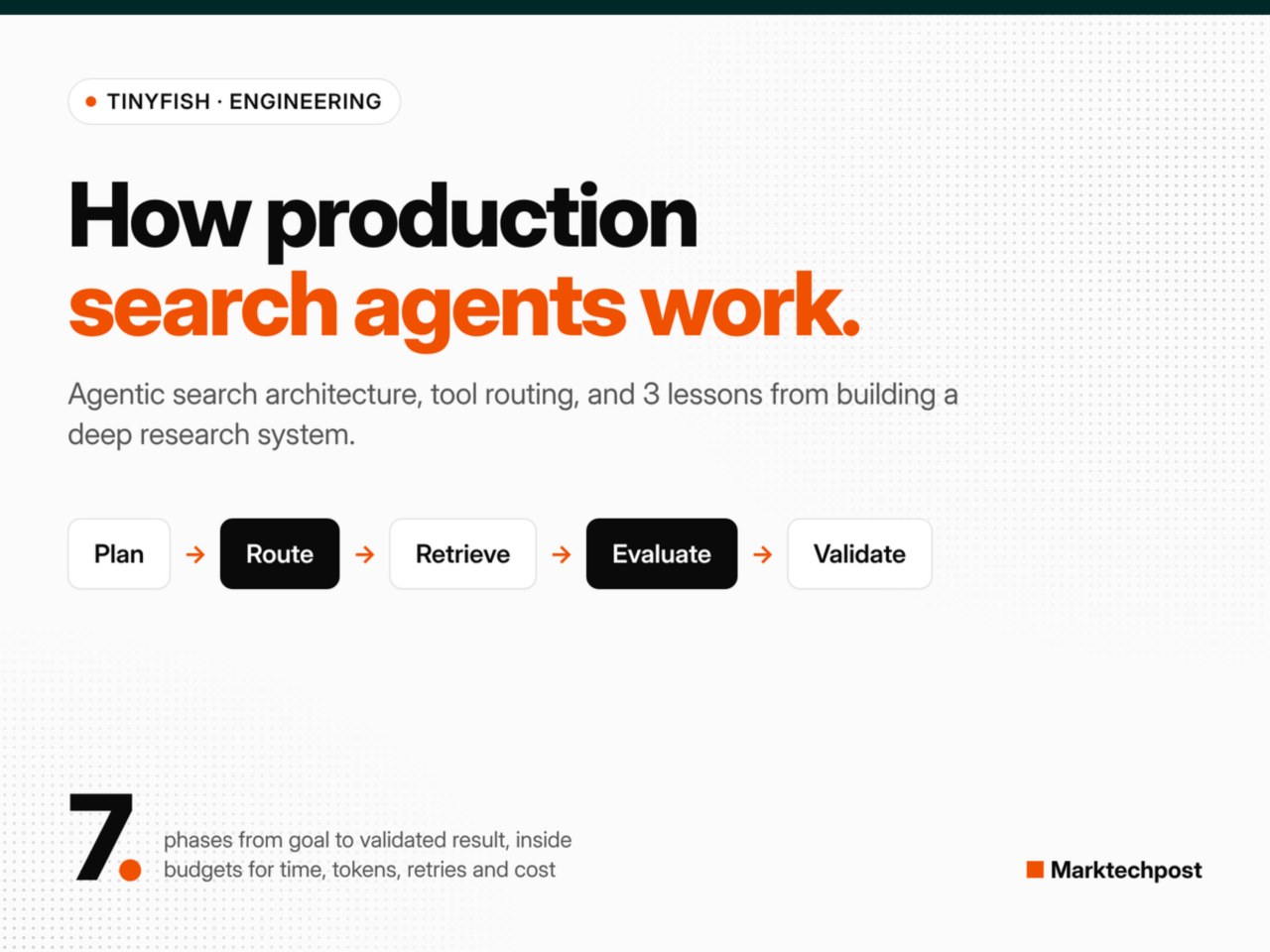
TinyFish has unveiled an agentic search architecture designed for production AI agents. The system is built on four web primitives: TinySearch, TinyFetch, TinyBrowser, and TinyAgent. It operates through a seven-phase control loop that separates reasoning from execution, utilizing typed tool interfaces to manage state, tool invocation, and output validation.
In testing on OpenBenchmarks, the architecture achieved a 79.0% completion rate on coding tasks. The system recorded a median task cost of $0.050 per task. In a search-only configuration, TinyFish reached a 59.3% completion rate, while benchmarks for Perplexity, Firecrawl, and Exa Fast were 77.3%, 70.3%, and 66.3% respectively.
The development team moved away from using standalone planners and separate subagents for each query, opting instead for a unified reasoning loop within the orchestrator. This change reduced context-switching overhead and latency. The team also implemented an internal evaluation harness using an LLM judge to assess report quality, relevance, and citation trust.
Engineering efforts focused on addressing the lost-in-retrieval problem and optimizing context management. The architecture incorporates failure-specific retries and strict caps on tokens, execution time, and tool usage. These guardrails prevent issues like unintended form submissions during browser retries and ensure the agent remains focused on specific research objectives.