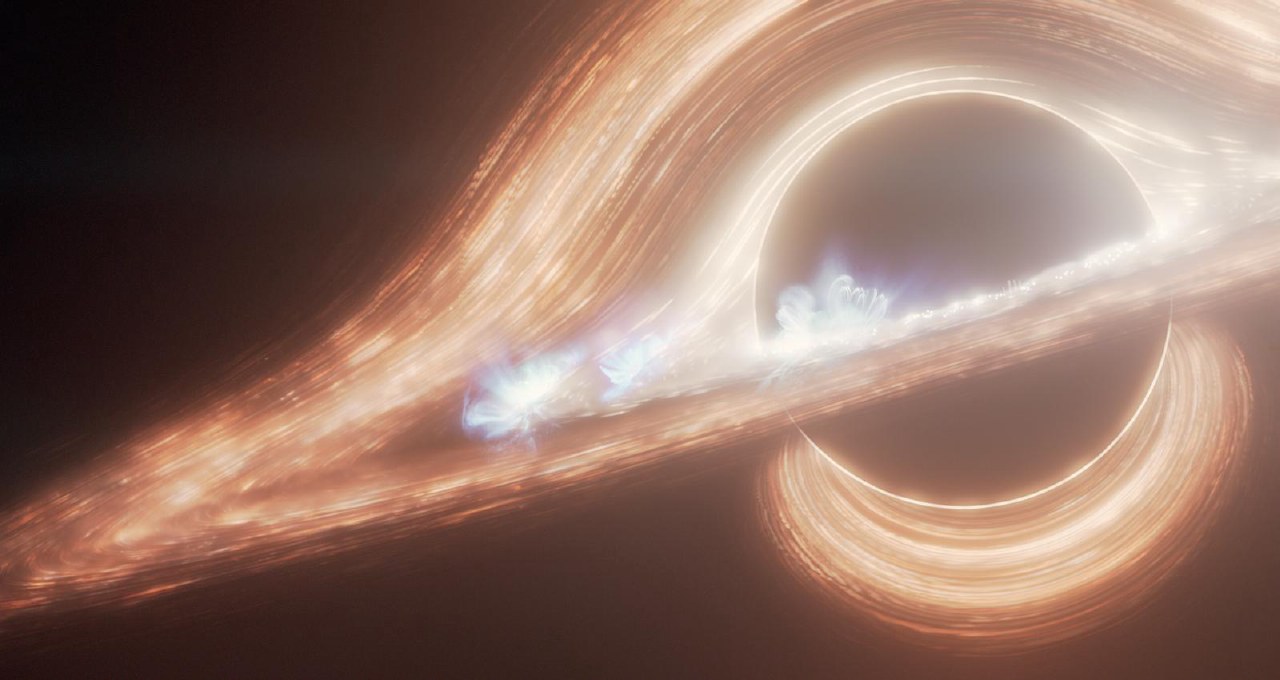
Researchers published a study in Physical Review D exploring the theoretical possibility of black hole fragmentation. While the second law of thermodynamics generally prohibits this process by requiring entropy to increase, the team identified specific conditions where this restriction might be bypassed.
For non-rotating black holes, splitting would decrease the total surface area of the event horizons, violating thermodynamic laws. However, calculations for rapidly rotating Kerr black holes suggest that if the objects rotate near the maximum speed and move apart, fragmentation could be physically permissible.
The study describes this geometric scenario as a pair-of-pants topology, where a single event horizon splits into two. The authors also examined alternative mechanisms, including the Gregory-Laflamme instability in theories with extra dimensions and effects related to superradiance.
While the research does not confirm that black holes actually split, it outlines conditions under which such a process is not forbidden. Co-author Francesco Sannino suggests that primordial black holes from the early universe might be more prone to fragmentation than standard astrophysical objects.
Scientists propose using gamma-ray telescopes, such as the Fermi-LAT observatory, to search for radiation signatures from tiny black hole fragments. This observational approach could help determine if such scenarios occur in the real universe, pending further developments in gravity theories.