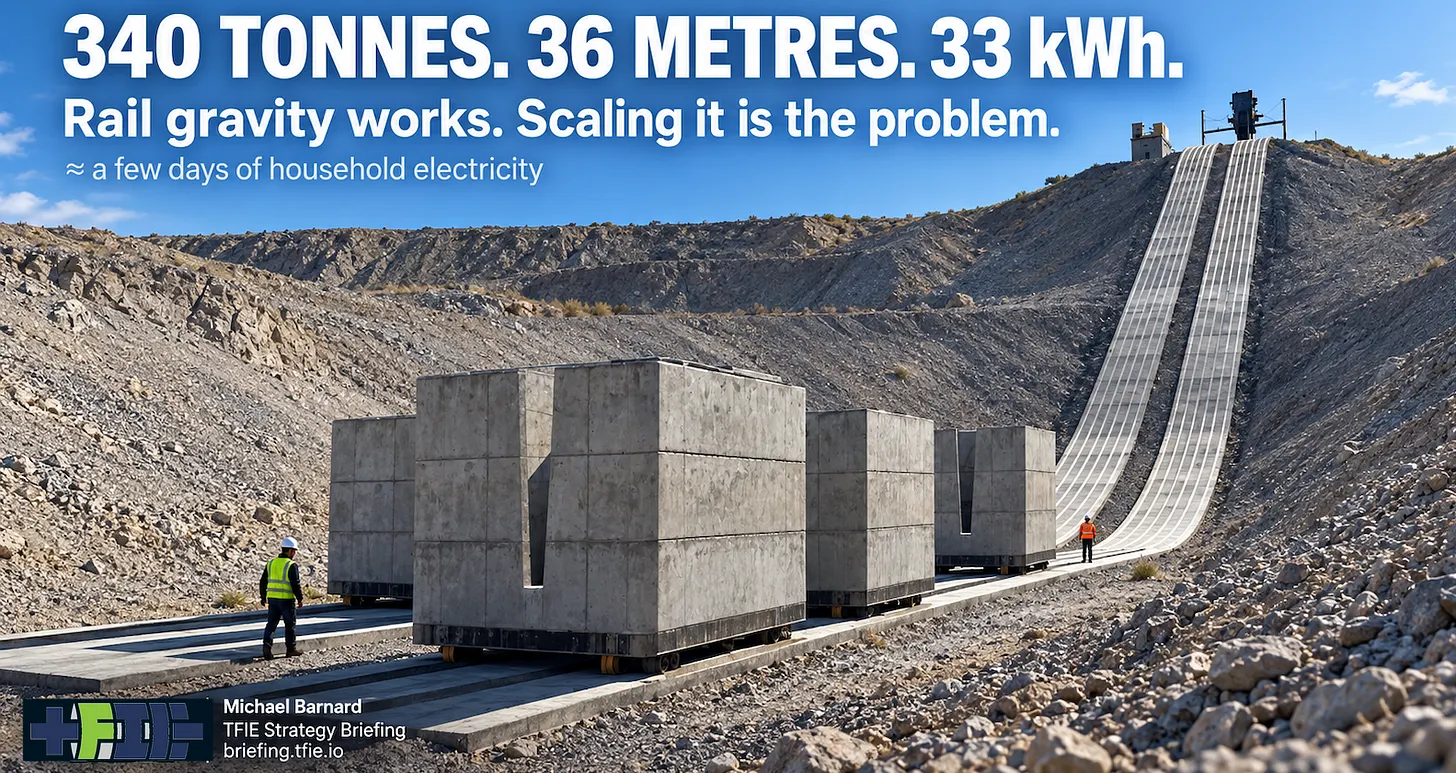
ARES North America has operated its GravityLine system at the Gamebird Pit in Nevada. Sandia National Laboratories documented that the system uses a stationary motor and chain drive to move two mass cars, weighing approximately 340 tonnes, up a 55% grade slope over an elevation of 36 metres. This process stores about 33 kWh of gross gravitational energy.
The analysis compares the ARES system to pumped hydro and lithium-ion storage. For a hypothetical 20 MW plant providing 400 MWh of energy over 20 hours with a 400-metre elevation, the system requires hundreds of thousands of tonnes of mass. This necessitates the construction of specialized heavy rail infrastructure, including custom carriers, storage areas, and maintenance facilities.
Unlike pumped hydro, which uses water as a self-leveling medium, rail gravity storage requires individual chassis, bearings, and parking positions for each unit of mass. The system also lacks the scalability of lithium-ion batteries, which are produced in standardized global factories rather than requiring site-specific heavy equipment manufacturing.
The author notes that Britain’s 2026 long-duration storage procurement includes lithium-ion projects capable of operating for over ten hours. This challenges the assumption that mechanical storage is necessary for long-duration needs. Additionally, the construction of rail gravity plants involves significant use of steel and cement, resulting in a high embodied carbon footprint.