

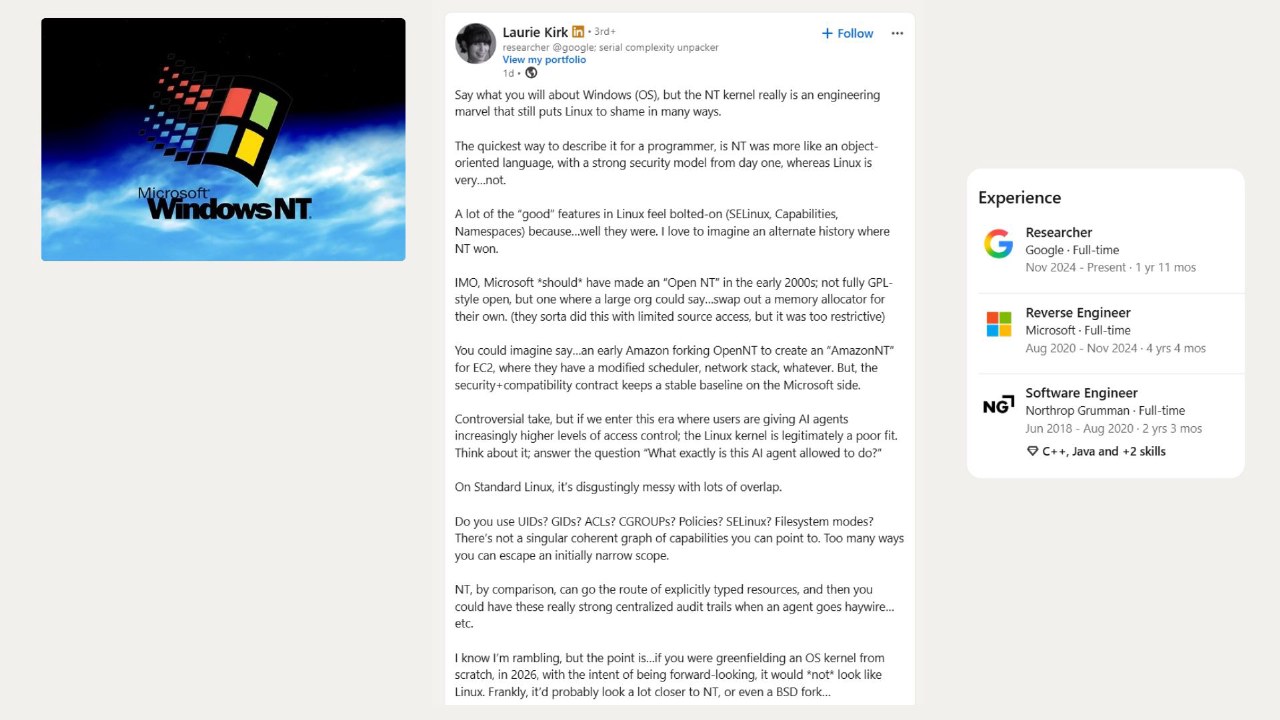
Google researcher Laurie Kirk, a former Microsoft reverse engineer, recently revisited the debate between Windows NT and Linux. She described the Windows NT kernel as an engineering marvel, highlighting its object-oriented design and security model established at its inception. Unlike Linux, which added security mechanisms like SELinux and Namespaces over time, NT has utilized a centralized object management system since its 1993 debut.
The NT architecture manages resources such as processes, files, and devices as objects, utilizing handles and access tokens to enforce permissions. Kirk argues this unified approach provides clearer audit trails, which she believes is increasingly relevant for managing AI agents that perform thousands of autonomous operations. Microsoft is currently leveraging these legacy NT mechanisms, such as Access Control Lists (ACLs), to address security challenges posed by AI agents.
Kirk proposed a hypothetical 'Open NT' model where enterprises could have modified the kernel while maintaining core compatibility. However, industry experts, including Linux developer David Airlie, note that the long-term maintenance costs for such forks are prohibitive. Historically, Microsoft shared source code with approximately 1,600 organizations via the Shared Source initiative and the Windows Research Kernel, but never allowed commercial branching.
While Linux dominates the server and cloud sectors, Microsoft continues to integrate Linux support through the Windows Subsystem for Linux (WSL). Meanwhile, the industry is exploring new security frameworks like FreeBSD's Capsicum to better manage process permissions. Ultimately, the debate centers on how modern operating systems should define and control access rights as software increasingly acts on behalf of human users.



