

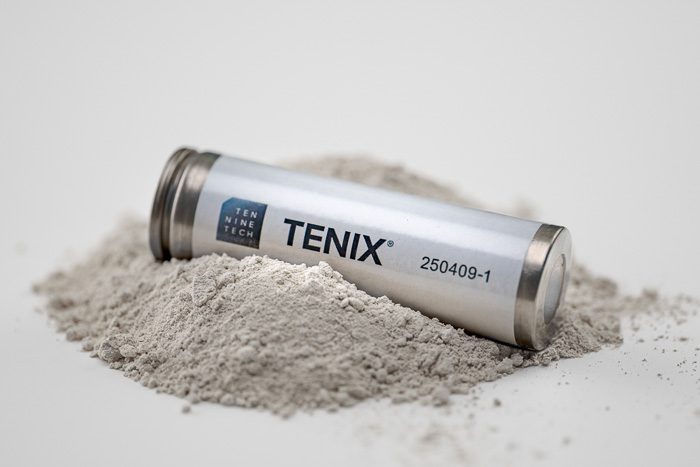
Ten-Nine Technologies has launched commercial-scale production of its TENIX cathode additive at a new facility in Tulsa, Oklahoma. The additive is designed to prevent chemical decomposition in batteries, which typically degrades performance over time. Manufacturers can integrate the product into existing production lines without requiring new equipment or battery redesigns.
The additive is mixed into cathode material at a ratio of 0.5–2% by weight. According to third-party testing, TENIX increases charge-discharge cycles by over 75%, extending the expected battery life from 150 000 miles to over 265 000 miles. These improvements result in a roughly 40% reduction in cost per kilowatt-hour over the battery's lifespan and a 10% decrease in internal resistance.
The company aims to address the cycle life limitations of manganese-rich cathodes, which are viewed as a more abundant and affordable alternative to nickel- and cobalt-heavy chemistries. Ten-Nine currently reports a production capacity of 100 tons, sufficient to treat between 50 000 and 200 000 standard electric vehicle battery packs.
Ten-Nine Technologies is currently conducting evaluation trials with battery manufacturers that collectively account for more than half of global production volume. The company is now accepting orders for delivery in 2026–2027 from its Oklahoma plant. CEO Paige Johnson stated that the additive's surface chemistry is intended to disrupt the battery aging process at the source.


