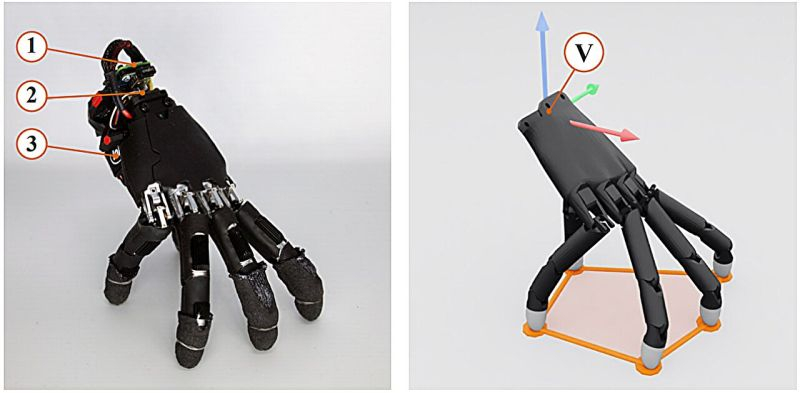
Engineers from the Soft Robotics Lab at the Swiss Federal Institute of Technology in Zurich have developed a robotic hand capable of autonomous movement and object manipulation. The device, which detaches from a standard robotic arm, is designed to operate in confined spaces where a full-sized robot cannot fit.
The team integrated a battery, sensors, and a compact computer into the wrist area. To enable locomotion, researchers utilized a computer model and reinforcement learning. The prototype successfully navigated 14 different surface types, including gravel, metal grates, grass, and carpets.
In mobility tests, the hand successfully transitioned from a lying position to a standing one in 21 out of 25 attempts. During precision tasks, the device balanced on four fingers to press specific cursor keys, achieving success in 29 out of 32 trials.
Additional experiments required the hand to move an object on a table to within 2 cm of a target location. The developers believe this technology will improve the integration of humanoid robots into human environments by allowing them to perform autonomous tasks in restricted areas.