

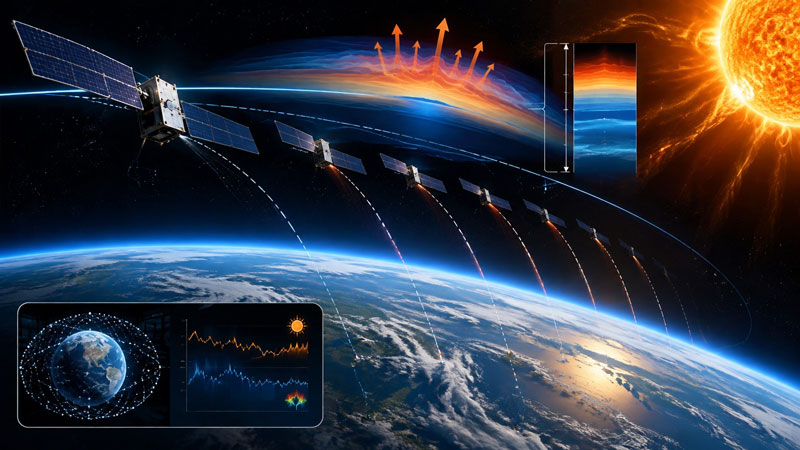
Astronomer Tony Phillips has proposed utilizing low Earth orbit satellite constellations as a distributed sensor network to monitor the Earth's upper atmosphere. By analyzing orbital decay, researchers can measure atmospheric density changes caused by solar activity.
The method relies on publicly available Two-Line Element (TLE) data provided by the US Space Command. The B* parameter, which accounts for atmospheric drag in orbital models, serves as a proxy for air density at altitudes between 90 and 600 kilometers.
The study incorporates data from approximately 1000 Starlink satellites, 391 Amazon Kuiper units, 651 Eutelsat OneWeb spacecraft, and 107 Planet Labs SuperDove satellites. These diverse orbital altitudes allow for a comprehensive analysis of different atmospheric layers.
Solar ultraviolet radiation and geomagnetic storms cause the thermosphere to expand, increasing drag on satellites. Phillips notes that atmospheric response to solar radio emissions typically occurs within two days, providing a statistical tool for space weather forecasting.
While satellite maneuvers and the inherent limitations of TLE data present challenges, the large volume of tracked objects allows researchers to filter out individual station-keeping activities and isolate broader atmospheric trends.



