

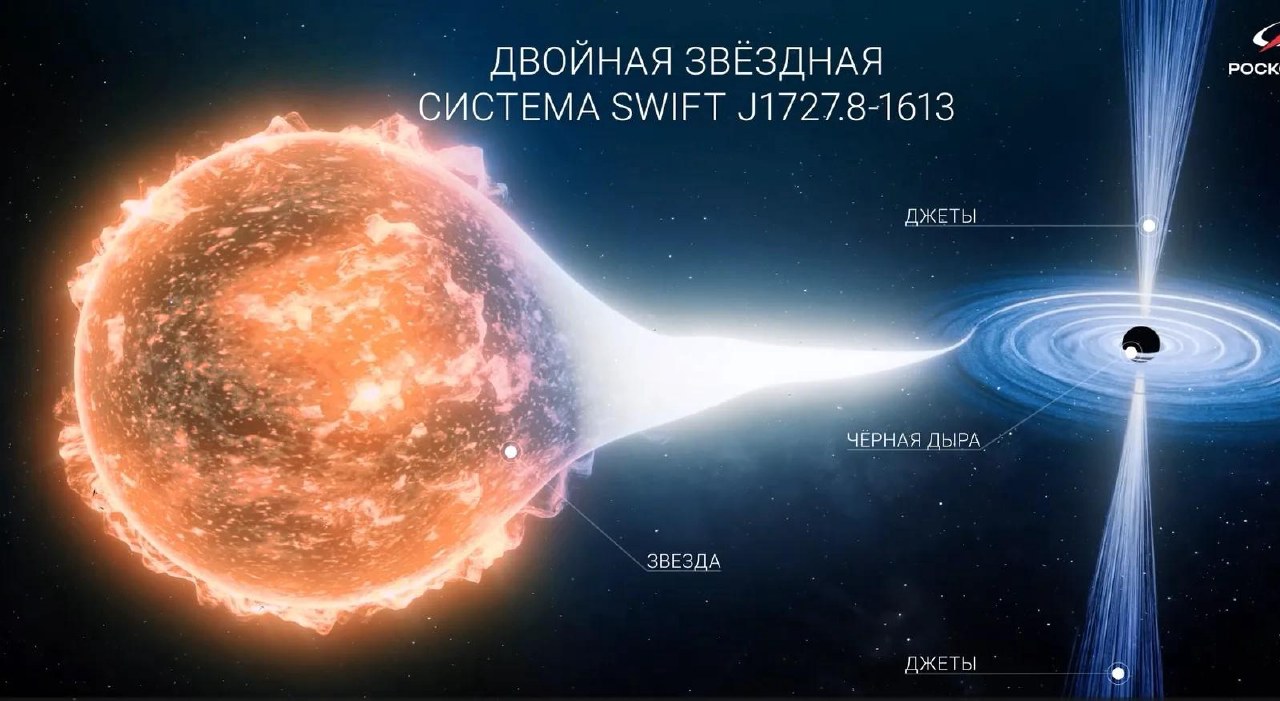
Roscosmos and the Spektr-RG observatory team have released artistic visualizations of five space objects. These images are based on data from the ART-XC X-ray telescope, developed by the Space Research Institute of the Russian Academy of Sciences. The objects include a black hole binary, a millisecond pulsar, a supernova, a distant quasar, and the Hercules X-1 system.
The ART-XC telescope operates in the 4–30 keV hard X-ray energy range. It is designed to study accretion processes near compact objects like black holes and neutron stars. According to Alexander Lutovinov, deputy director of the Space Research Institute, the team is actively developing X-ray mirror manufacturing technologies, with data being shared with the Russian scientific community.
The project also explores autonomous spacecraft navigation using pulsars. Because these neutron stars emit regular radiation pulses, they can serve as cosmic beacons. This technology aims to allow spacecraft to determine their position in deep space independently, without relying on continuous signal exchange with Earth.
Despite technical constraints on onboard systems, the scientific program of the Spektr-RG observatory remains active. The team continues to expand its catalog of X-ray sources, using these visualizations to illustrate complex astrophysical phenomena for the public.



