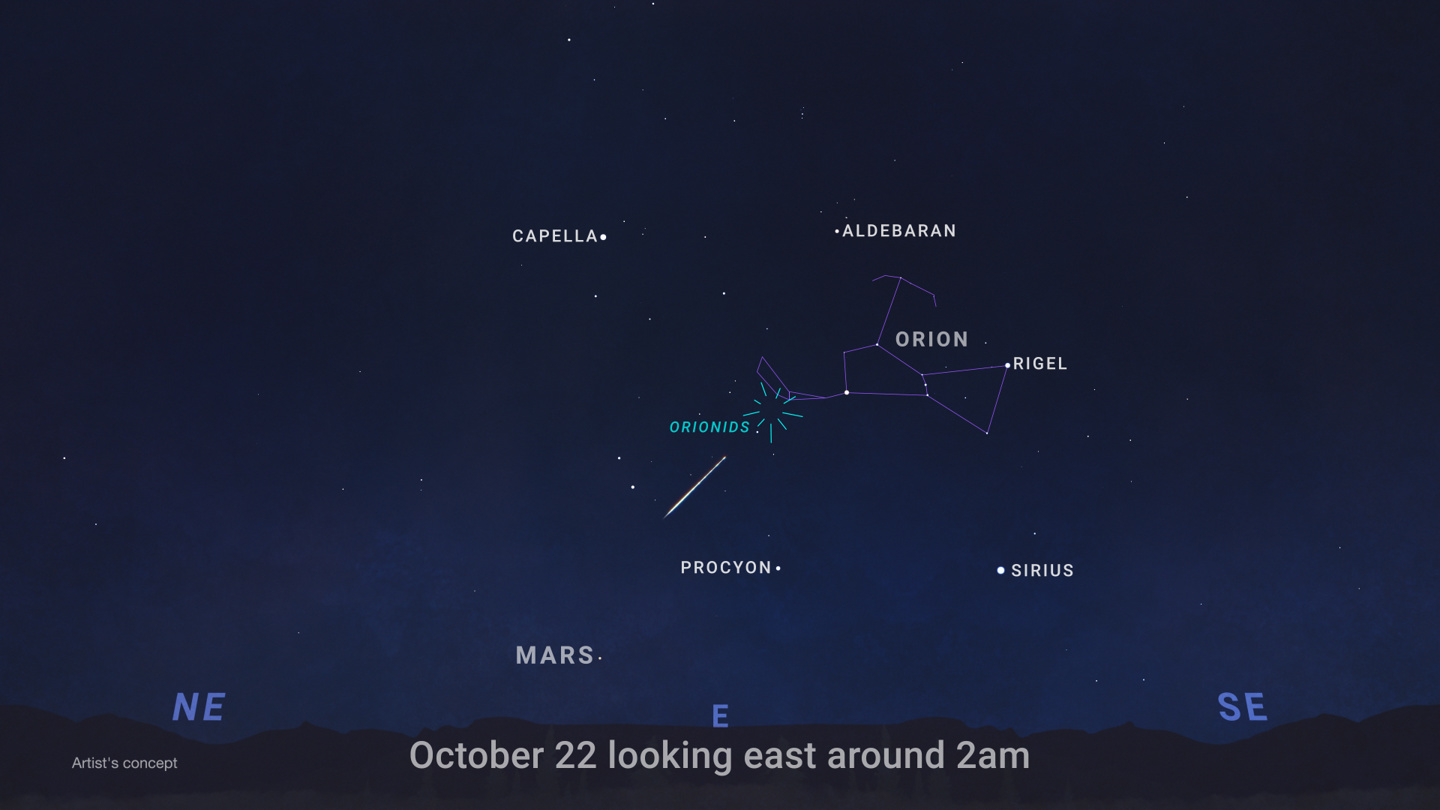
The annual Orionid meteor shower will reach its peak activity on the nights of October 21 and 22, 2026. Observers in both the Northern and Southern Hemispheres can view the event without specialized equipment, as the meteors are visible to the naked eye.
Under ideal conditions, the Zenithal Hourly Rate (ZHR) is estimated at 20 meteors per hour. The meteors originate from debris left by Halley's Comet, entering the atmosphere at a speed of approximately 66 km/s. Some meteors may leave glowing trails or appear as bright fireballs.
Observing conditions this year will be affected by the moon, which will be in a waxing gibbous phase with an illumination of approximately 80% during the peak. NASA recommends waiting until the moon sets before dawn to minimize light interference.
The radiant point of the shower is located near the star Betelgeuse in the Orion constellation. However, meteors can appear in any part of the sky. Experts advise choosing a location with minimal light pollution and allowing 20 to 30 minutes for eyes to adjust to the darkness.