

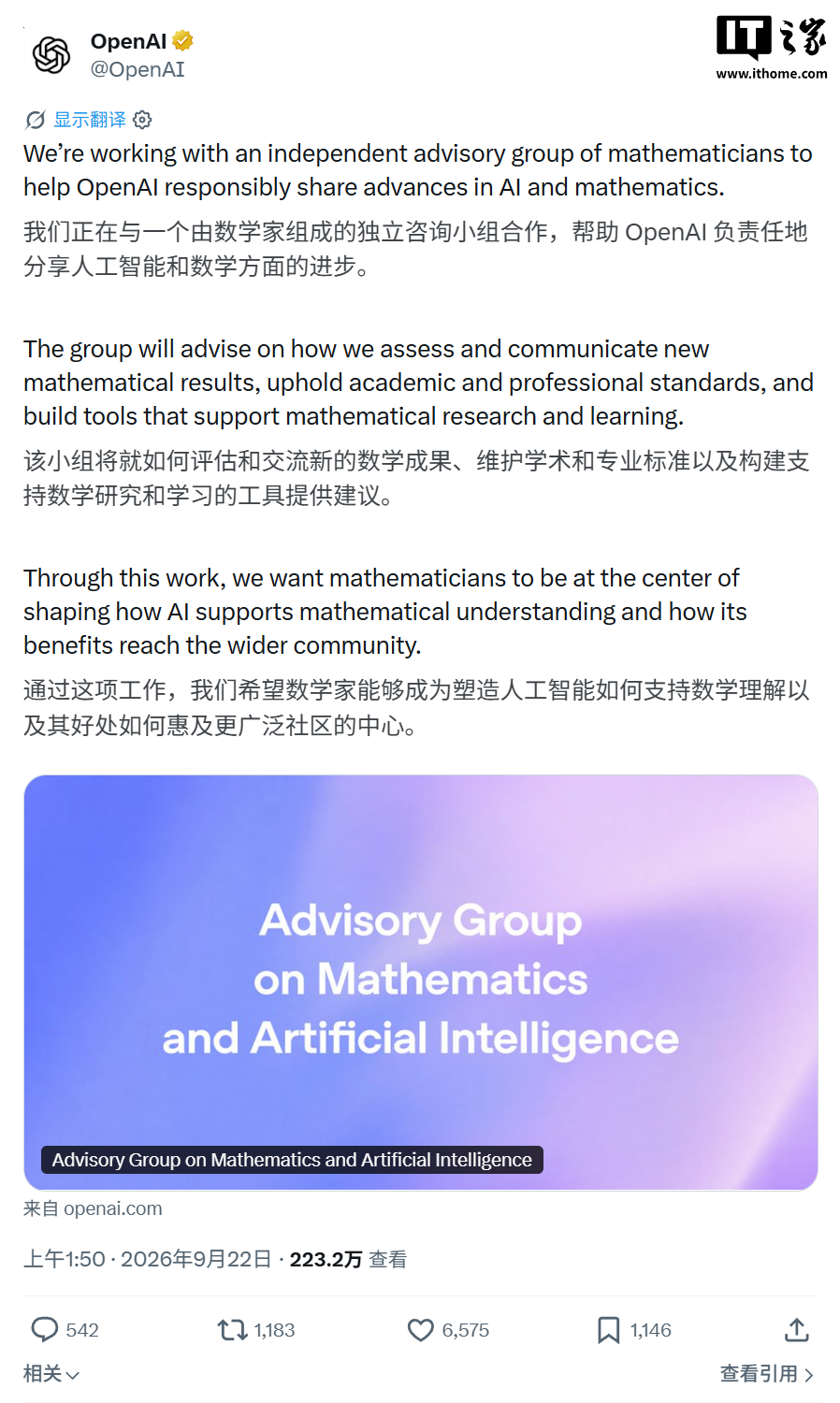
OpenAI has established an Advisory Group on Mathematics and Artificial Intelligence, based at the Institute for Advanced Study in Princeton. The group consists of nine mathematicians who will operate independently of the company. Members will not receive compensation from OpenAI and retain the right to offer unsolicited advice or publicly comment on the company's impact on mathematics.
The advisory board is tasked with evaluating the significance of new findings, providing guidance on academic standards, and suggesting ways to improve the dissemination of research. Additionally, the group will advise on how OpenAI tools can support mathematical learning and research. However, the board will not provide recommendations regarding the internal pace of the company's mathematical research.
OpenAI also reported that a new, undisclosed model, which began training on August 28, has successfully solved over 100 long-standing open problems across various mathematical fields. This list includes the Navier-Stokes existence and smoothness problem, one of the Millennium Prize problems. The company noted that the speed of these discoveries prompted internal discussions on how to communicate these results to the academic community.
The company emphasized the need for a cautious approach to deploying AI capabilities in fundamental science. This decision follows an open letter from mathematicians, including Terence Tao, Yu Deng, and Peter Scholze, who expressed concerns regarding the use of open mathematical problems as benchmarks for new AI systems. OpenAI stated that it intends to engage in more comprehensive communication with the mathematical community.


