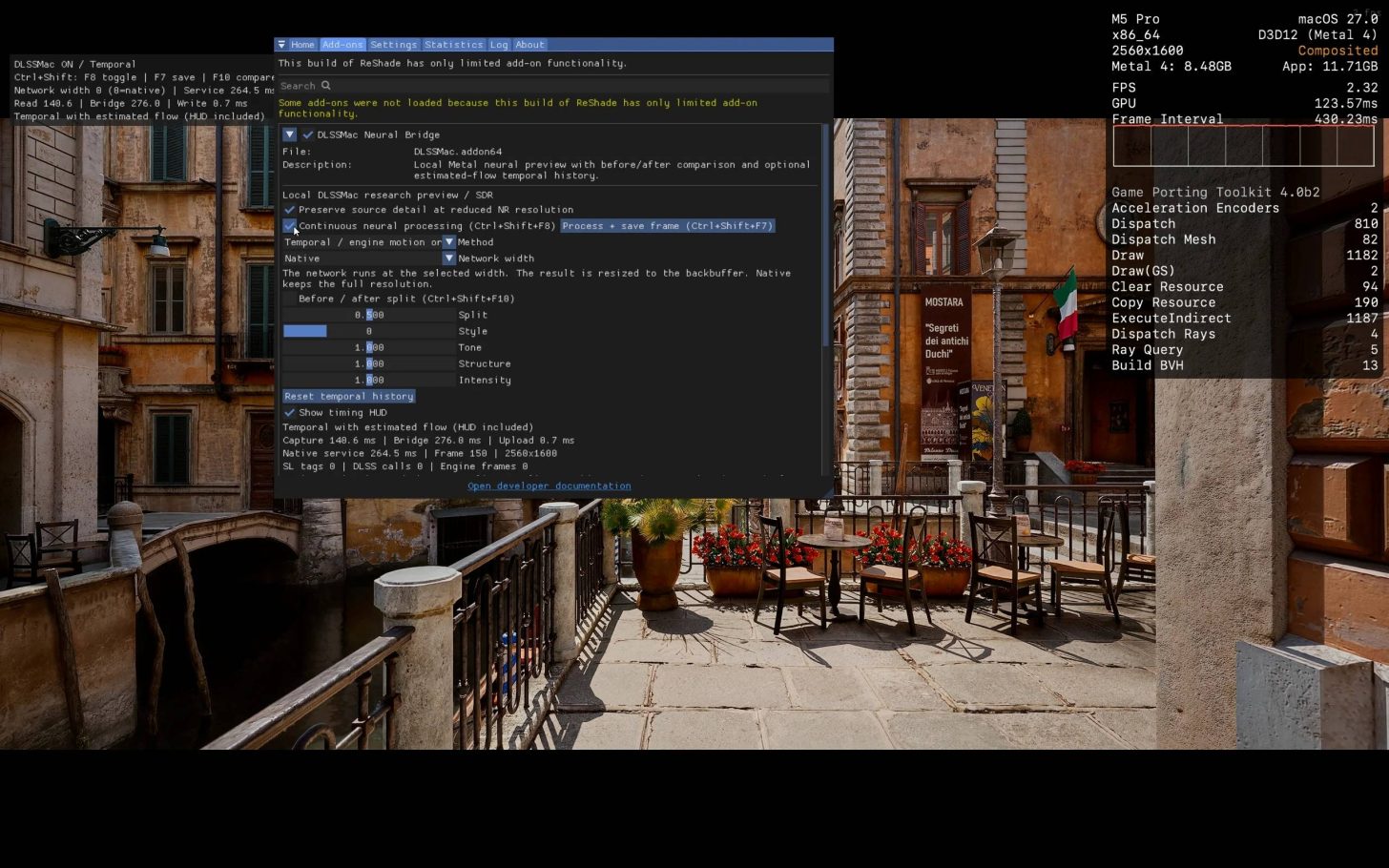
Developer @iamwavecut ported the DLSS 5 neural rendering model to Apple Silicon. Developer @Mappsnet7 integrated the Metal backend into Windows games using ReShade and Game Porting Toolkit 4.0b2.
Testing on an M5 Pro chip with a 16-core GPU showed improvements in surface lighting, ambient occlusion, and spatial depth when DLSS 5 was enabled.
However, performance dropped significantly. At 1440p resolution, the frame rate fell to 2.32 FPS, and input lag reached 240 ms.
The performance loss is attributed to insufficient FP8 support. DLSS 5 relies on FP8 precision for neural network inference, but the M5 Pro lacks dedicated hardware units for this, forcing the workload to run via FP16 paths.
In terms of raw power, the M5 Pro's 16-core GPU has an FP8 peak performance of 26 TOPS, while a desktop RTX 5050 provides approximately 105 TOPS, which is about four times higher.