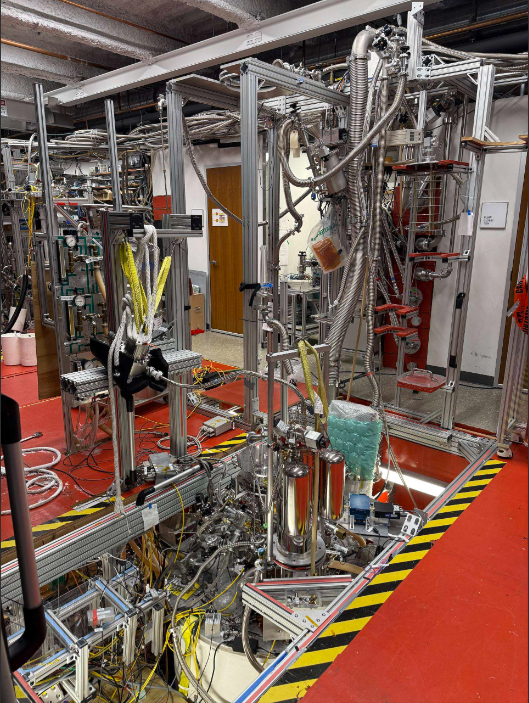
Physicists at Northwestern University have successfully trapped a single positron for several months. To achieve this, the team captured particles from radioactive decay and cooled them to temperatures near absolute zero. The positrons were then suspended in a near-perfect vacuum to prevent annihilation upon contact with ordinary matter.
The researchers developed a device called a single-positron quantum cyclotron. This setup allows the positron to function like an artificial atom with specific quantum energy levels, enabling precise control and observation. The study, published on October 21 in Physical Review Letters, aims to test the fundamental symmetry between electrons and their antimatter counterparts.
By measuring the magnetic properties of the positron with unprecedented precision, scientists intend to conduct the most rigorous test of the Standard Model of particle physics to date. Discrepancies in these measurements could provide insights into why the universe is dominated by ordinary matter rather than antimatter, challenging existing theoretical frameworks.