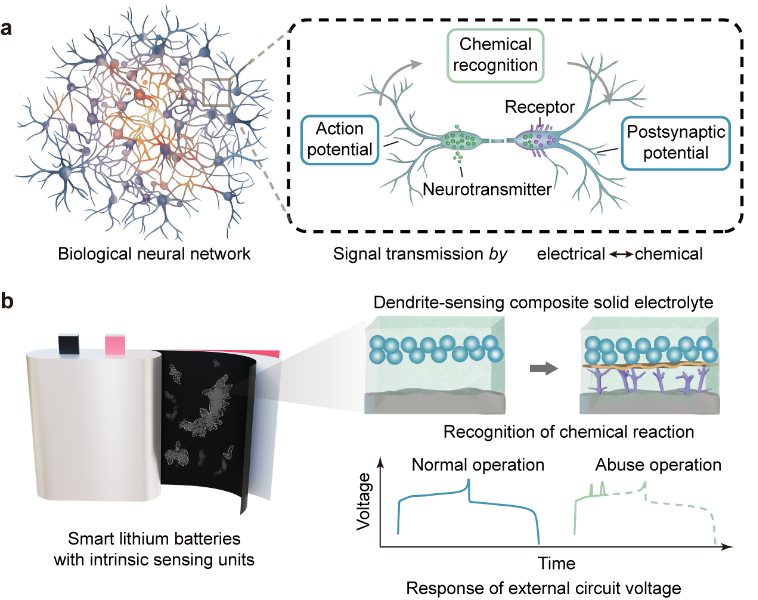
Researchers at the Institute of Chemistry, Chinese Academy of Sciences, have developed a new composite solid-state electrolyte designed for smart lithium batteries. The team, led by Guo Yuguo, integrated inorganic solid-state electrolyte nanoparticles as sensing units within a polymer protective layer.
The system mimics the signal transmission mechanism of biological neurons. When lithium dendrites penetrate the polymer layer and reach the inorganic components, an interfacial chemical reaction is triggered. This process converts microscopic dendrite penetration into a macroscopic voltage signal.
This technology allows the battery to generate a distinct external voltage response before a severe internal short circuit occurs. The innovation shifts the role of solid-state electrolytes from passive dendrite suppression to active dendrite sensing and early warning.
The research was supported by the Chinese Academy of Sciences, the National Natural Science Foundation of China, and the Beijing Natural Science Foundation. This approach provides a new design paradigm for enhancing the safety and intelligence of lithium secondary batteries.