

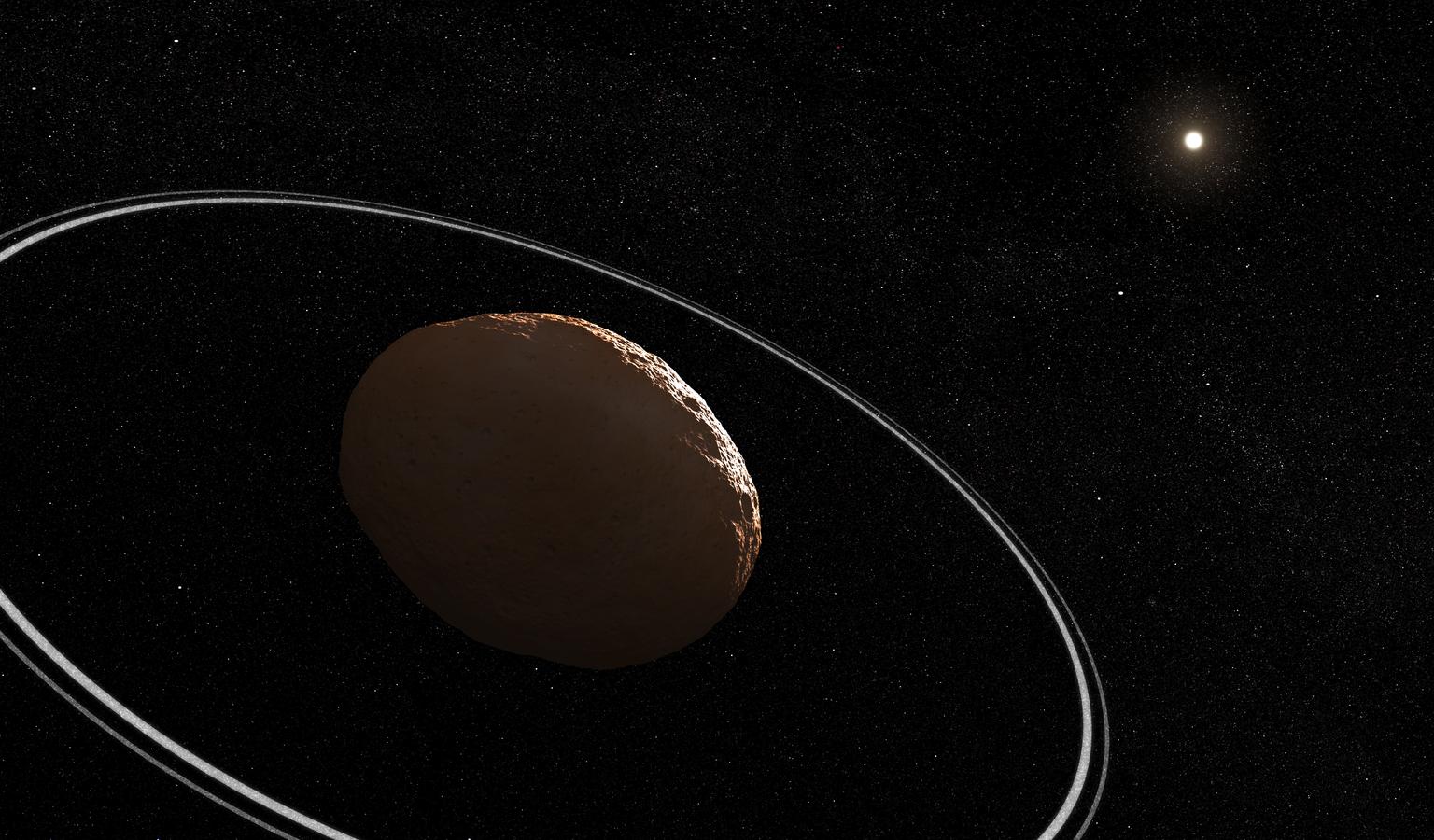
The James Webb Space Telescope (JWST) has observed significant changes in the ring system of Chariklo, a 250-kilometer-wide centaur orbiting between Saturn and Uranus. Data collected on October 18, 2022, during a stellar occultation event, reveals that the inner ring, C1R, has become significantly denser, while the outer ring, C2R, is now barely detectable.
Observations were conducted in two near-infrared bands at 1.5 and 3.2 micrometers. The inner ring C1R showed an increase in blocked starlight from 0.303 to 0.431. Researchers from the Institute of Astrophysics of Andalusia performed 10 million simulations to verify these findings, concluding that the inner ring has physically thickened, gaining approximately 10 times more material than the outer ring lost.
The outer ring C2R was nearly invisible at 1.5 micrometers and completely absent at 3.2 micrometers. Scientists hypothesize that a small, yet-to-be-detected satellite orbiting near the outer ring may be responsible for the observed stability, sharp boundaries, and the redistribution of material between the rings.
This study marks the first direct observation of ring evolution for a small body in the solar system. Similar ring structures have previously been identified on other objects, including Chiron, Haumea, and Quaoar. These findings suggest that small bodies exhibit dynamic ring behavior comparable to the changes observed in the rings of giant planets like Saturn and Neptune.



