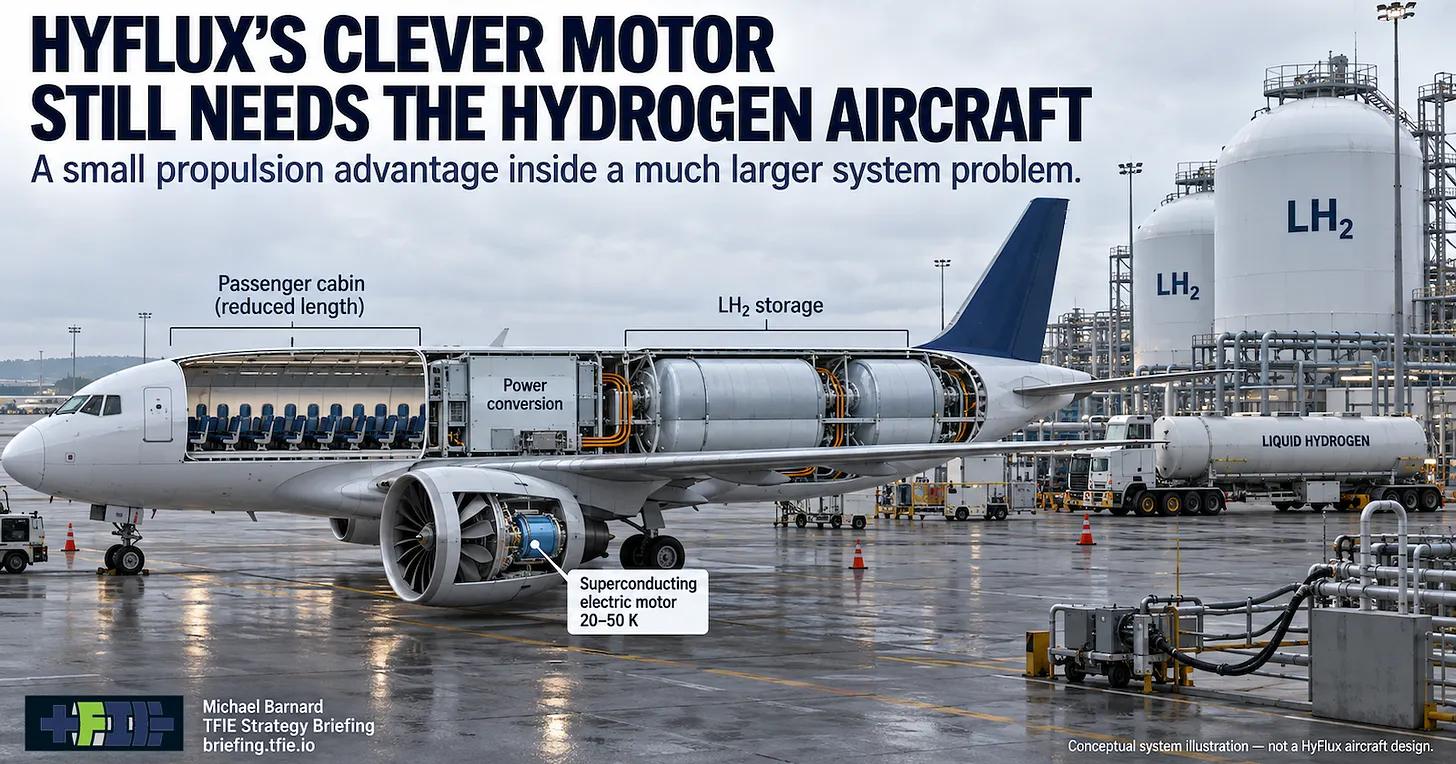
British startup HyFlux has developed a fully superconducting electric motor designed for aviation, utilizing liquid hydrogen as a coolant. The company claims the motor achieves a power density exceeding 20 kW/kg, surpassing the 16 kW/kg target set by the NASA Glenn High-Efficiency Megawatt Motor program. The design leverages the -253 degrees Celsius temperature of onboard hydrogen fuel to maintain the motor's superconducting state.
Despite the technical milestone, the project faces significant integration challenges. HyFlux has only publicly demonstrated a 100-kilowatt prototype, leaving questions about the final weight of a flight-ready system once power electronics, cryogenic piping, and safety shielding are added. Managing extreme cold and ensuring maintenance in standard airport environments remain critical operational hurdles.
Market viability presents the greatest risk for the startup. A September 2026 analysis estimates the probability of commercial hydrogen passenger aircraft appearing by 2050 at less than 1%. While the motor addresses weight concerns, it does not resolve broader industry issues such as hydrogen's low volumetric energy density, the need for specialized cryogenic tanks, and the massive capital investment required for airport refueling infrastructure.
The company faces stiff competition from alternative technologies. Battery-powered aircraft are steadily increasing their range, hybrid systems are expanding operational capabilities, and traditional turbines are being adapted for sustainable aviation fuels. Consequently, HyFlux is betting both on the long-term performance of its superconducting hardware and the uncertain emergence of a large-scale commercial hydrogen aviation market.