

The UK Civil Aviation Authority has launched its Hydrogen Challenge, focusing on hydrogen-aircraft turnarounds, cryogenic storage, and airside supply at London City Airport. The regulator aims to support scaled operations for small hydrogen-powered aircraft by 2035.
Industry players are also advancing hydrogen technology. Airbus and MTU are developing a certifiable hydrogen fuel-cell engine, while ZeroAvia has made progress toward FAA certification for its 600 kW electric engine.
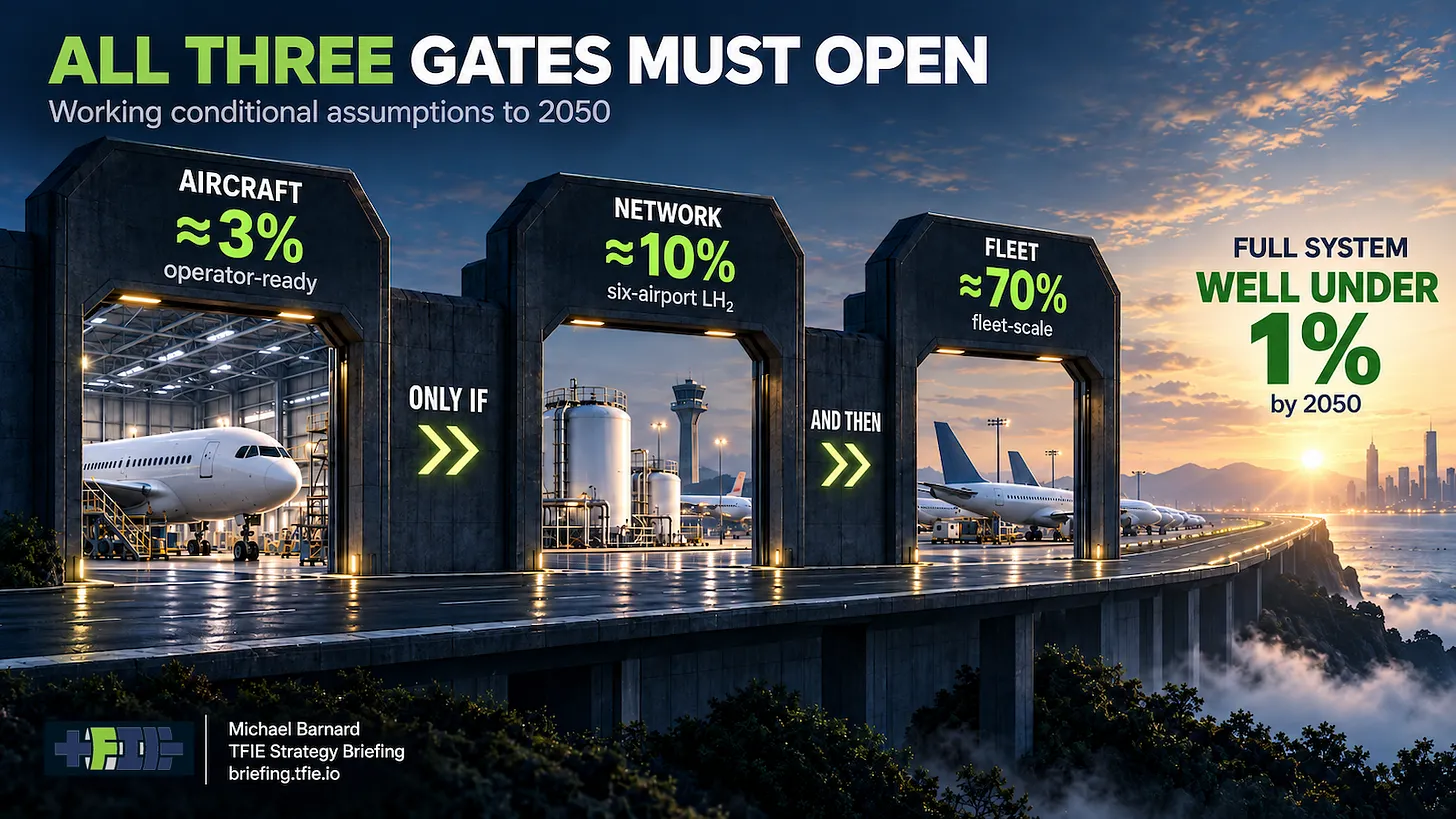
Despite these efforts, a new assessment of a 150-passenger aircraft flying 2,500 kilometers suggests significant hurdles. Even with optimistic assumptions for individual development stages, the probability of an operator-ready aircraft by 2050 is estimated at roughly 3%.
When accounting for the necessary airport infrastructure, such as liquefaction, pipelines, and supply logistics, the outlook for a complete medium-haul passenger system drops well below 1% by 2050. The analysis emphasizes that aircraft production, fuel networks, and fleet scaling must mature simultaneously to be viable.
Hydrogen-powered aviation faces competition from liquid fuels that utilize existing turbine architectures and airport infrastructure. While sustainable aviation fuels have their own constraints, hydrogen requires a more extensive replacement of the current aviation system to achieve the same transport capacity.


