

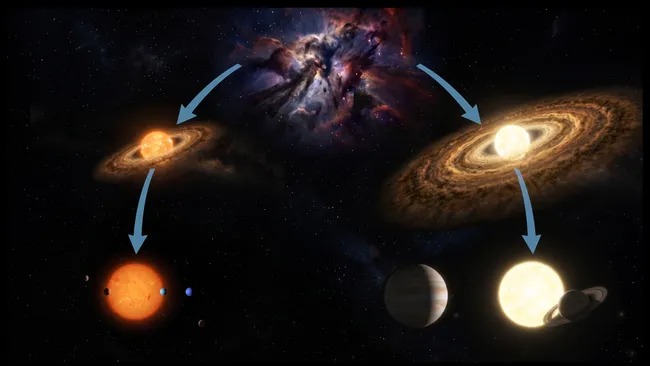
A research team led by the Italian National Institute for Astrophysics (INAF) analyzed 300 planetary systems within the Milky Way. The study, published in Nature Astronomy on October 13, identifies two distinct categories of planetary systems based on their evolutionary paths.
The first category consists of massive, expansive systems with a total mass two to ten times that of our solar system. These systems orbit stars larger than the Sun with lower heavy-element content. They frequently experience violent gravitational disturbances, such as collisions or ejections of planets.
The second category features compact systems where planets share similar masses and sizes. These orbit stars with mass and metallicity equal to or lower than the Sun. These systems are characterized by stable orbits and a lack of significant gravitational instability compared to the first group.
Researchers utilized computer simulations to confirm that the host star's properties dictate the system's formation and subsequent evolution. The study concludes that the initial environment provided by the host star determines whether a system remains stable or undergoes chaotic development.



