

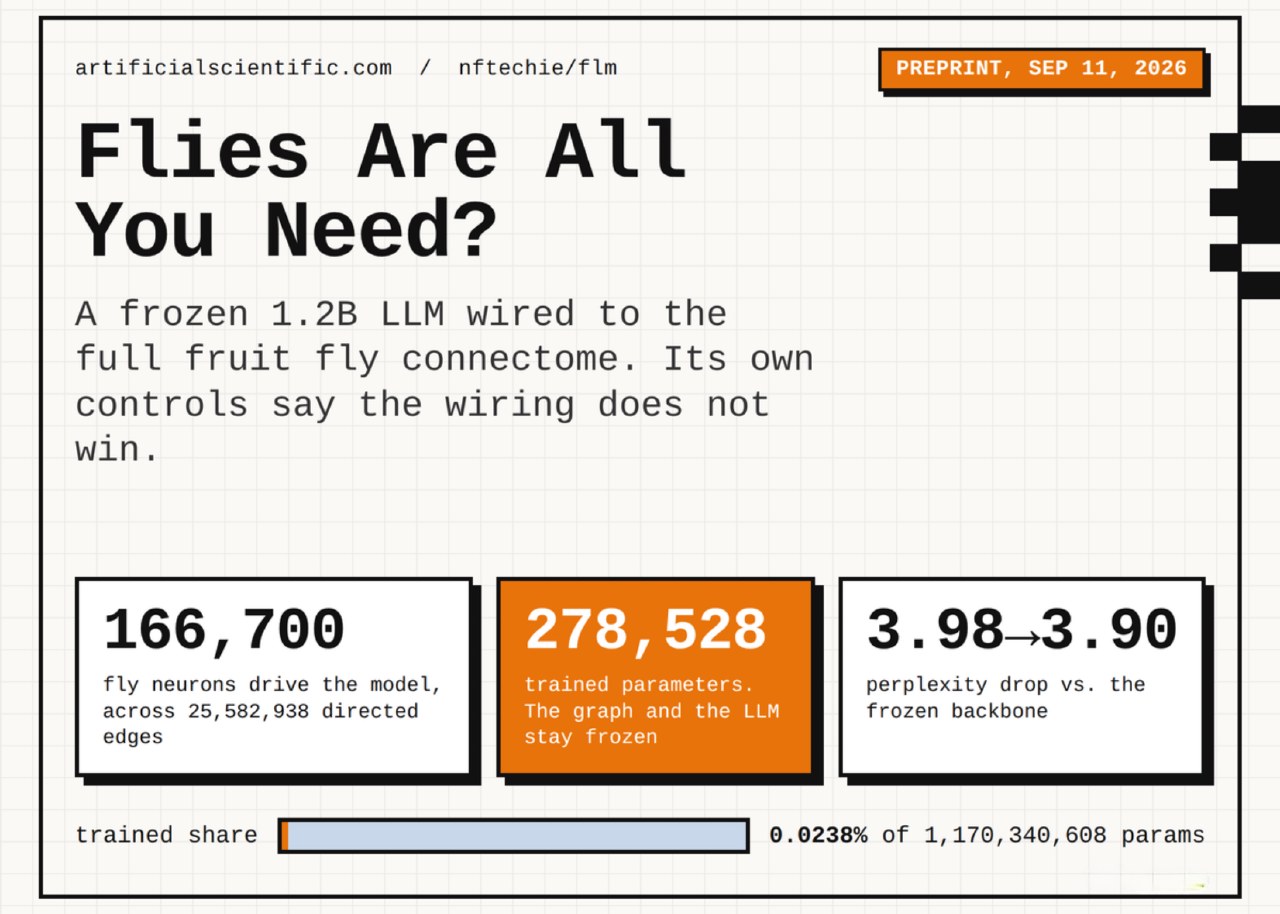
The Fly Language Model (FLM) integrates the full MaleCNS connectome of a fruit fly into a frozen 1.2 billion parameter large language model. The system utilizes 166,700 nodes and over 25.5 million directed edges. The architecture functions as a reservoir computer where only a 278,528-parameter readout is trained, representing 0.0238% of the backbone.
Performance tests on 32 SmolTalk dialogues showed the model achieved a perplexity of 3.90, compared to 3.98 for the backbone. However, control tests using direct input without the graph structure outperformed the FLM. Statistical analysis indicates that the specific fly topology does not provide a measurable gain over random wiring or direct input methods.
The research demonstrates that the recurrence within the graph contracts initial-state differences rapidly, limiting long-term memory capabilities. The system relies on the backbone for linguistic competence. The project is available under an MIT license on GitHub, supports Python 3.12, and runs locally on macOS or Linux without requiring API keys.
This implementation follows a previous prototype, ngxson/fly-hf, which utilized a smaller subset of the central brain. The current FLM distinguishes itself through the use of the full retained graph and a frozen-backbone design, allowing researchers to isolate the source of language performance.



