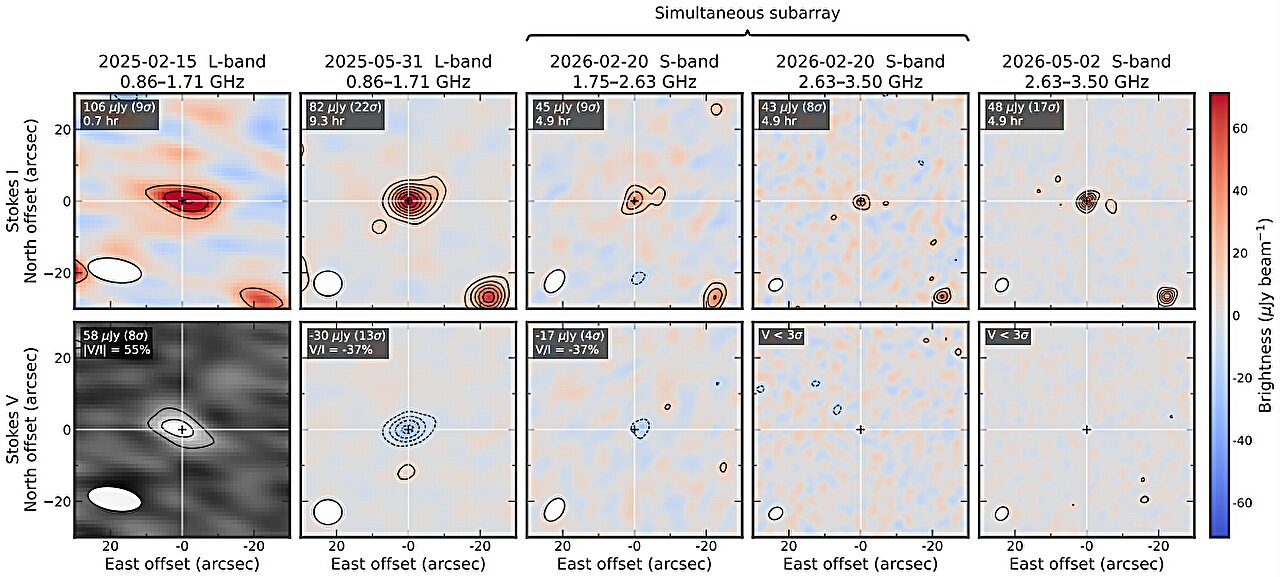
Researchers from the Harvard-Smithsonian Center for Astrophysics have detected radio signals from the exoplanet Beta Pictoris b. The team utilized the MeerKAT radio telescope array in South Africa to capture the emissions, which were detailed in a preprint paper published on arXiv on September 15.
The signals were identified as originating from the planet rather than its host star, Beta Pictoris, located 63 light-years away. Observations conducted between 2025 and 2026 revealed rapid, circularly polarized radio bursts in the 0.85 to 3.5 GHz range, a characteristic typical of auroral emissions generated by electron cyclotron maser instability.
Analysis of the radiation frequency allowed scientists to estimate the magnetic field strength of Beta Pictoris b at no less than 1250 Gauss. This measurement represents the first direct calculation of an exoplanet's magnetic field, which is significantly stronger than the 0.5 Gauss field of Earth and the 14 Gauss field of Jupiter.
Beta Pictoris b, discovered in 2008, has a mass approximately 12 times that of Jupiter and a rotation period of 8 to 9 hours. Future research aims to expand this detection method to seven other giant exoplanets in five nearby star systems, utilizing next-generation radio telescopes expected to offer 5 to 7 times higher sensitivity.