Researchers at ETH Zurich have developed a method to produce miniature OLED pixels using photolithography, a process typically reserved for semiconductor manufacturing. This approach overcomes the traditional incompatibility between organic light-emitting materials and the harsh chemical solvents used in chip production.
The team created a new class of light-emitting polymers that function as both OLED materials and photoresists. These molecules feature a core-shell architecture, where a light-emitting organic core is protected by star-shaped chains that cross-link under ultraviolet light to form stable structures.
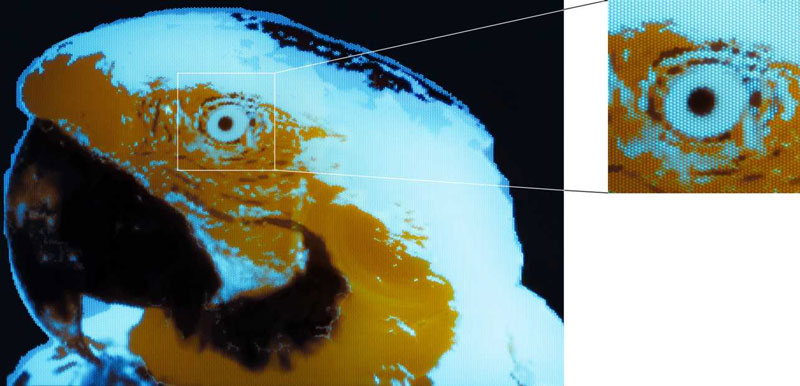
The researchers demonstrated the technology by creating a multicolored fluorescent image of a macaw measuring 300 by 430 micrometers, containing 250 by 350 pixels. This represents the highest resolution for a multicolored structure produced via photolithography to date.
Additionally, the team produced a 1 by 2.4 millimeter electrically controlled LED logo of ETH Zurich, serving as a prototype for future micro-displays. The technology is intended for use in augmented reality devices, biomedical systems, and microscopy applications.