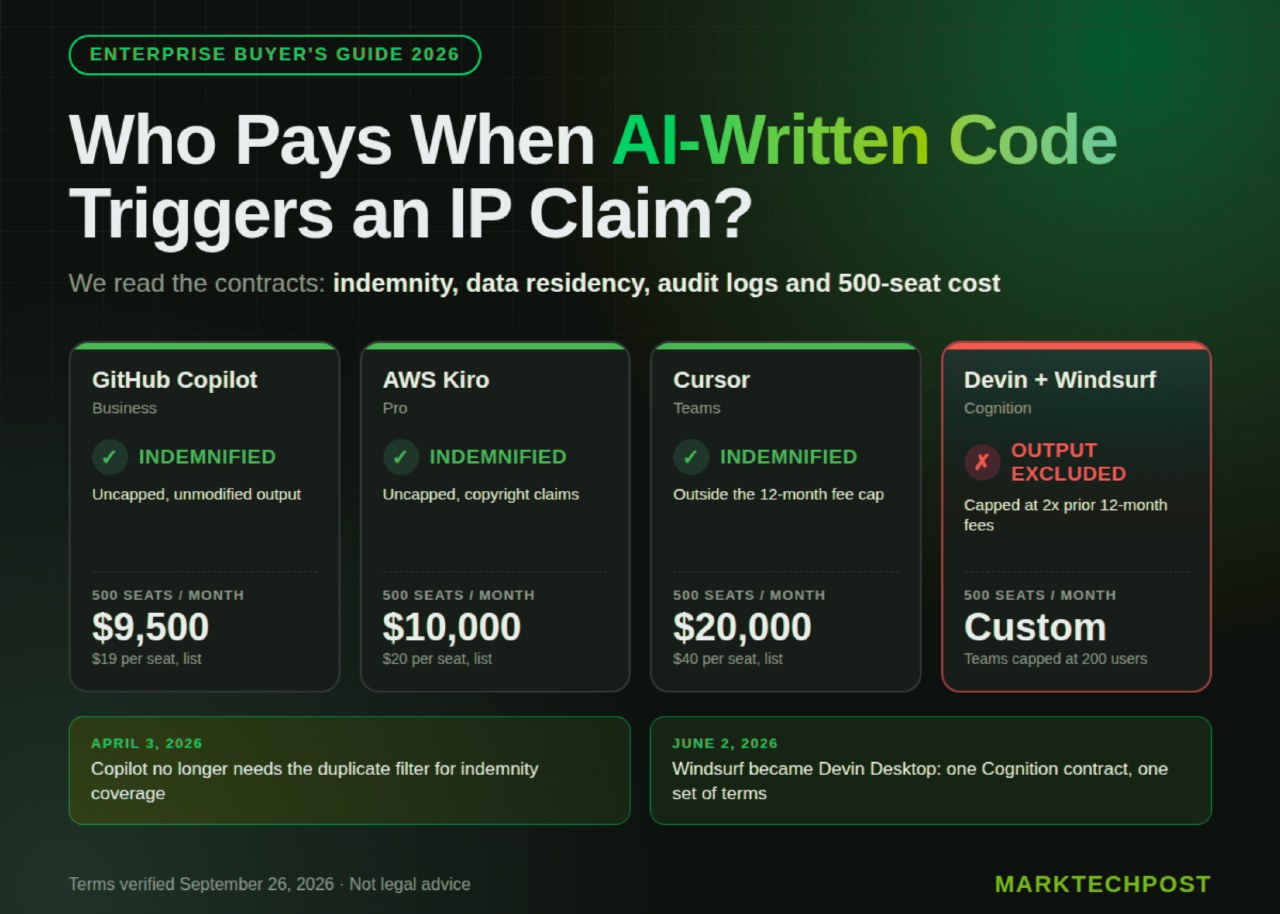
Enterprises evaluating AI coding agents must address four key areas: intellectual property indemnity, data residency, administrative logging, and total cost of ownership for 500 seats. Analysis of GitHub Copilot, AWS Kiro, Cursor, and Cognition products reveals significant variations in contract terms and operational security.
GitHub Copilot updated its indemnity policy on April 3, 2026, removing specific mitigation requirements for enterprise users. However, coverage remains limited to unmodified code. Cognition, which rebranded Windsurf to Devin Desktop on June 2, 2026, excludes generated output from its standard indemnity, capping liability at twice the trailing 12-month fees.
Data residency policies differ significantly across vendors. GitHub Enterprise Cloud allows pinning inference to the US or EU for a 10% premium on AI credits. AWS Kiro stores content in the configured region, while Cursor routes all requests through its backend without offering customer-selectable processing regions.
Administrative control and logging capabilities vary by tier. AWS Kiro allows logging prompts directly to a customer-controlled S3 bucket. GitHub Copilot logs agent activity for 180 days, though local prompts remain excluded. Cursor and Cognition restrict advanced audit logs and SSO features to their respective Enterprise plans.
Pricing models have shifted toward usage-based structures. GitHub transitioned to a credit-based system on June 1, 2026, where one credit equals $0.01. AWS Kiro charges $0.04 per credit. Organizations must account for these variable costs alongside base seat pricing when planning large-scale deployments.