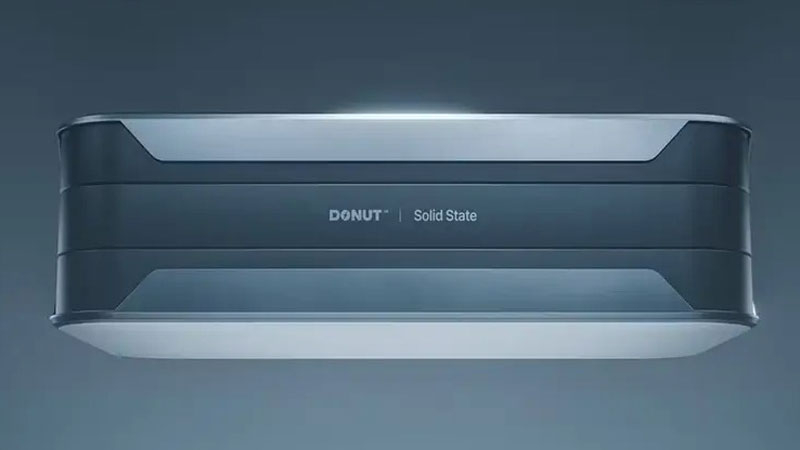
Finnish company Donut Lab tested its Donut Battery module at -30 °C. According to the VTT Technical Research Centre of Finland, the module retained 97% of its initial capacity and 93% of its stored power without any thermal protection.
The test involved a 48V module composed of 14 cells. At a room temperature of +25 °C, the unit demonstrated a capacity of 27.77 Ah and 1354 Wh of energy. After five hours in a climate chamber at -30 °C, the module delivered 26.8 Ah and 1254 Wh during a 1C discharge test.
The company previously claimed its solid-state battery would retain over 99% of its capacity at -30 °C, which differs from the VTT findings. The results also indicated a slight drop in operating voltage under freezing conditions.
Donut Lab faces scrutiny regarding the technology behind its batteries. In June 2026, a group of experts led by Ryan Inis Hughes concluded that the battery's performance characteristics resembled those of a high-quality lithium-ion cell rather than the claimed sodium-ion solid-state technology.
In September, Donut Lab provided analysis results from Intertek, which reported 3.4 ppm of lithium and 632 ppm of sodium. However, critics noted that the samples were submitted as crushed material rather than intact cells, leaving questions about the composition unresolved.