

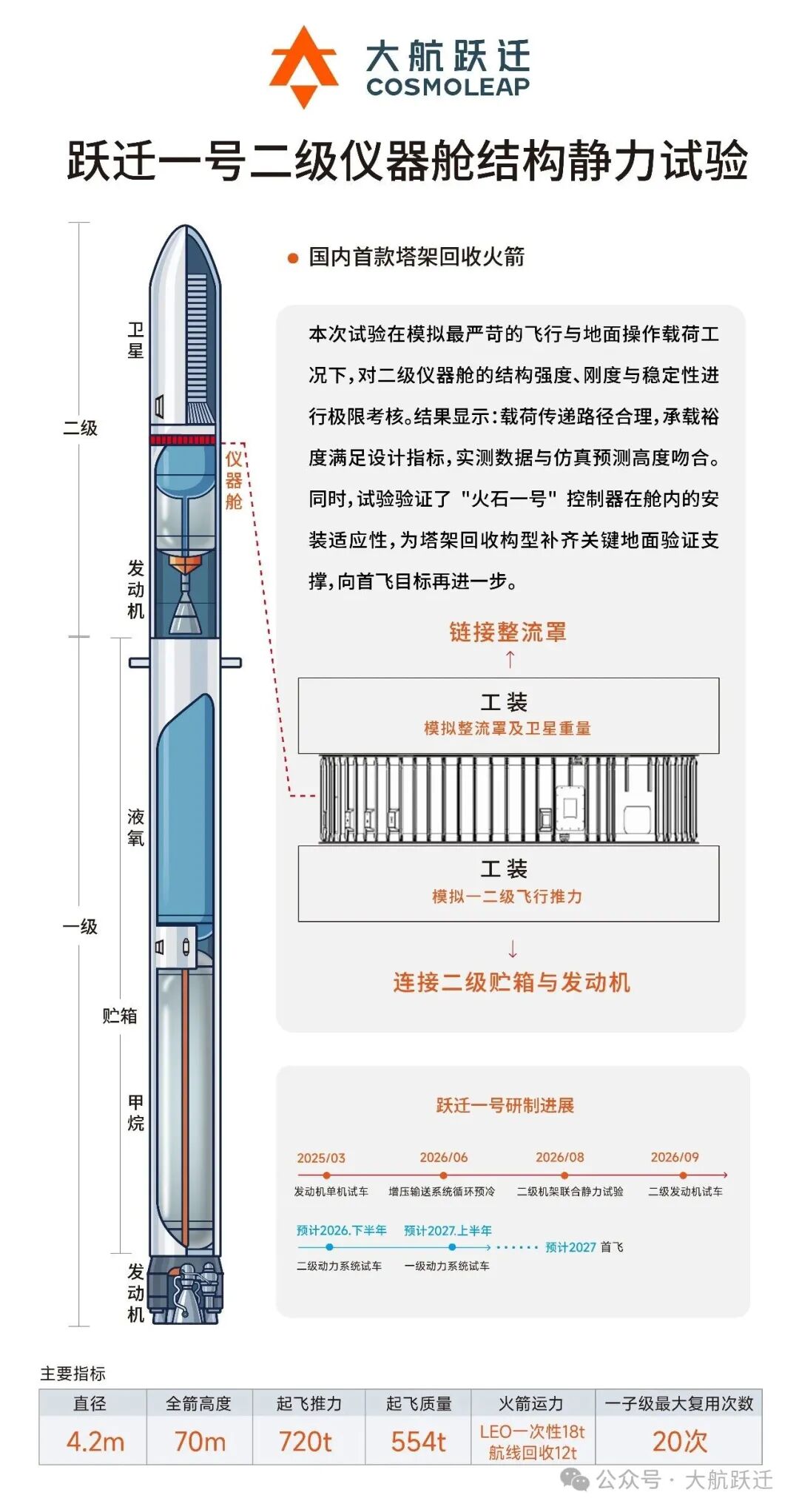
The Chinese aerospace startup Dahang Yueqian has successfully completed the static structural test of the second-stage instrument module for its Yueqian-1 rocket. The test confirmed that the module's strength, stiffness, and stability meet the design requirements, validating its reliability under various ground and flight load conditions.
The company recently achieved three major propulsion milestones in a single day, including the calibration of the second-stage engine, methane self-pressurization tests, and mechanical environment data collection. These successes follow earlier testing phases, such as the cryogenic circulation tests in June and the joint static tests of the engine frame and tank base in August.
Founded in February 2024, Dahang Yueqian focuses on developing medium-to-large reusable liquid rockets. The company is the first in China to adopt a tower-based 'chopstick' recovery system, which eliminates the need for landing legs. This design reduces the rocket's weight, increases payload capacity, and minimizes engine exhaust interference during landing.
The second-stage instrument module utilizes a lightweight design with optimized structural parameters and composite materials for instrument brackets. This approach aims to reduce vibration and overall weight, further enhancing the rocket's performance. The development process is accelerating, with the company aiming for the maiden flight of the Yueqian-1 in 2027.


