

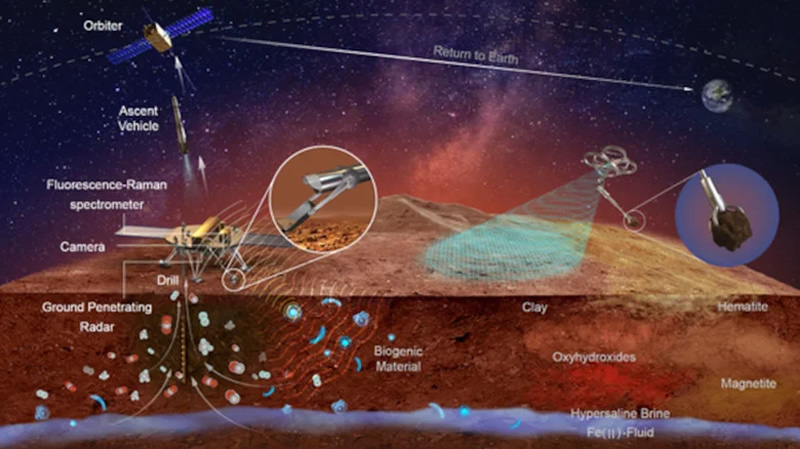
China has confirmed its schedule for the Tianwen-3 mission, aiming to deliver Martian soil samples to Earth by 2031. The launch of the spacecraft is planned for 2028, with the mission involving a three-year transit to Mars.
The mission will utilize a stationary lander to drill up to two meters deep and collect approximately 500 grams of material. Surface operations are expected to last about two months, after which the samples will be launched into orbit for return to Earth using two Long March 5 rockets.
Unlike the US Mars Sample Return (MSR) program, which relies on a rover, the Chinese mission features a simpler architecture. The project has currently entered the prototype development phase.
The US MSR program faces significant financial challenges, with cost estimates ranging from $7 billion to $11 billion. While Lockheed Martin proposed a $3 billion alternative, the timeline for returning samples collected by the Perseverance rover remains uncertain.
The NASA Authorization Act of 2026 proposes $8 billion in funding for the project, pending approval. China intends to maintain an open collaboration policy for the mission, focusing on the search for signs of life on Mars.



