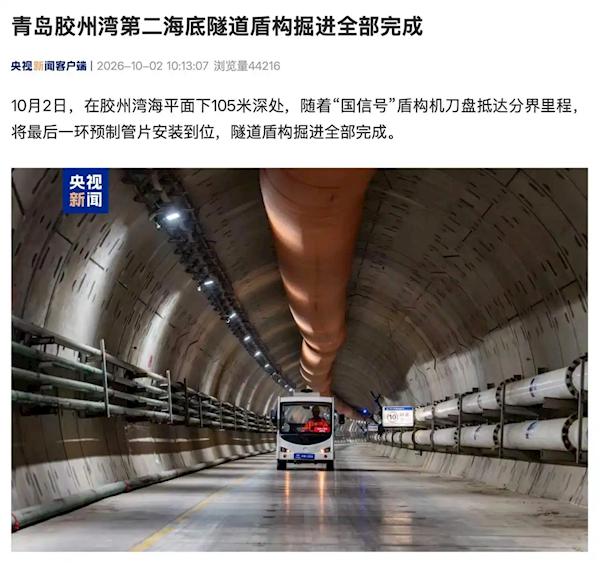
The project in Qingdao, China, has reached a major milestone as shield tunneling for the second Jiaozhou Bay subsea tunnel is now complete. The final tunnel boring machine reached its target depth of 105 meters below sea level. The infrastructure spans a total of 17.48 kilometers, featuring a 14.37-kilometer main section designed for six lanes of traffic with a speed limit of 80 km/h.
Construction utilized a mix of drill-and-blast methods and tunnel boring machines. Three machines were deployed: two with a diameter of 15.63 meters for the main tunnels and one 8.18-meter unit for the service tunnel. Work was complicated by geological conditions, as over 80% of the main route and 90% of the service tunnel consist of hard rock, with rock strength reaching up to 224 MPa.
The tunnel reaches a maximum depth of 95 meters below the seabed for the main section and 105 meters for the service tunnel. Due to high hydrostatic pressure, engineers implemented strict sealing and waterproofing standards. Once operational, this second subsea crossing will integrate with existing bridges and expressways to form a comprehensive transport network in the region.
The World Tunneling Association has recognized this project as one of the 50 landmark structures in the industry. It has set five world records, including the title of the world's largest subsea road tunnel by construction scale. The total volume of excavated earth and rock exceeds the amounts removed during the construction of the Seikan Tunnel in Japan and the Channel Tunnel.