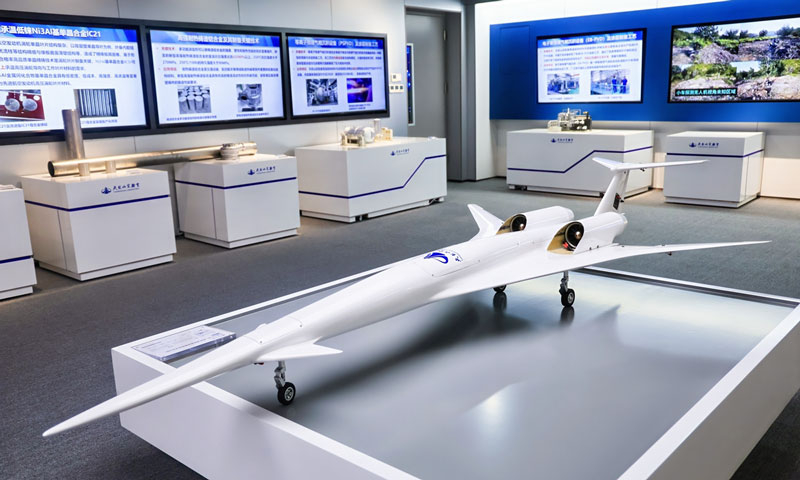
A Chinese aviation group has commenced the final assembly of the TMS-10, a demonstrator aircraft designed to test technologies for quiet supersonic passenger travel. The project focuses on minimizing the sonic boom through an optimized fuselage and wing design that manages shock wave distribution.
The aircraft utilizes three aerodynamic surfaces, including wings and a T-shaped tail, to control and weaken shock waves. A 3-meter prototype, weighing 12.5 kg with a 1.5-meter wingspan, successfully completed subsonic flight tests on June 30, 2025, at the Dingzhou airfield in Hebei province, reaching 0.2 Mach.
Engineers plan to conduct supersonic flight tests for the demonstrator before the end of 2026. The final goal of the TMS-10 program is to develop a business jet capable of carrying 10–15 passengers at a cruising speed of 2 Mach, with a subsonic speed capability of 0.9 Mach.
Once operational, the aircraft is expected to reduce travel time between Beijing and Shanghai to 30 minutes, compared to the current 2-hour flight duration. The development highlights a global shift toward supersonic civil aviation concepts that prioritize noise reduction and environmental efficiency.