

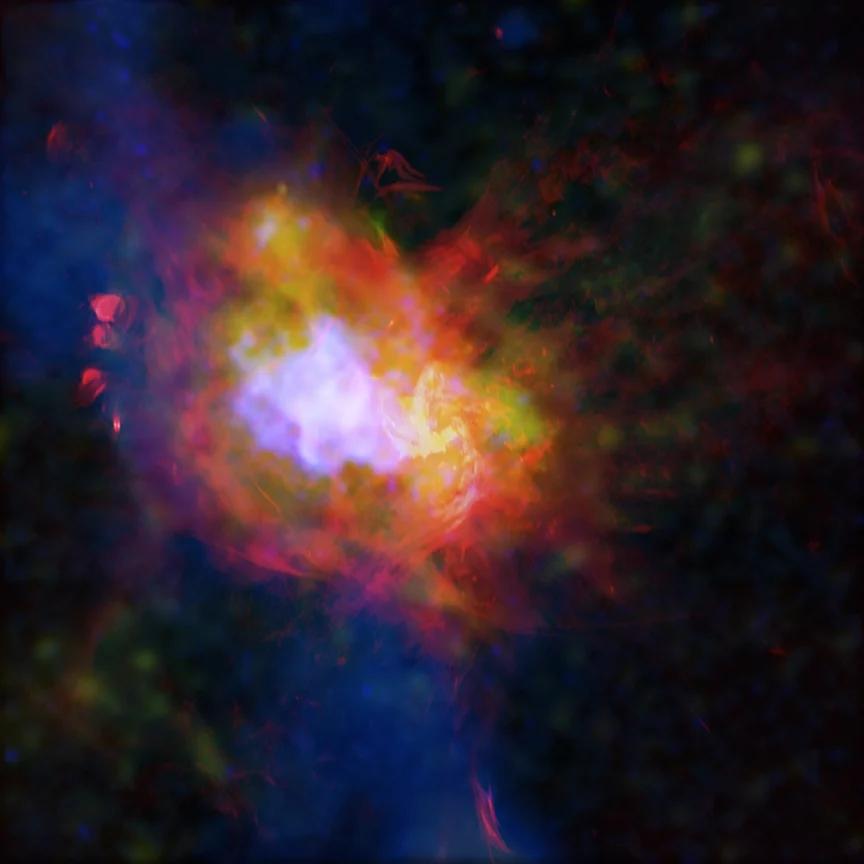
The Chandra X-ray Observatory has released a new composite image of the Milky Way's center, highlighting the supernova remnant Sgr A East. This remnant originated from a star that exploded near the galactic core approximately 10,000 years ago. The supermassive black hole Sgr A* is located slightly to the right, obscured by gas and dust.
A research team led by Mayura Balakrishnan from McGill University utilized a specialized source separation technique to isolate individual components in the region. This method allowed researchers to distinguish between the supernova, the black hole, stellar winds, and background stars, while mapping the distribution of iron, sulfur, argon, and calcium.
The data indicates that the expansion of Sgr A East has physically altered the surrounding environment. The explosion compressed and heated local material, creating cavities that define the three-dimensional structure of the area. The composite image integrates X-ray data from Chandra, radio observations from the Very Large Array, and submillimeter data from the James Clerk Maxwell Telescope.
Launched in 1999, the Chandra observatory remains a flagship mission. Current projections suggest the telescope could remain operational until the 2030s, although its future faces potential challenges from proposed budget cuts by the White House.


