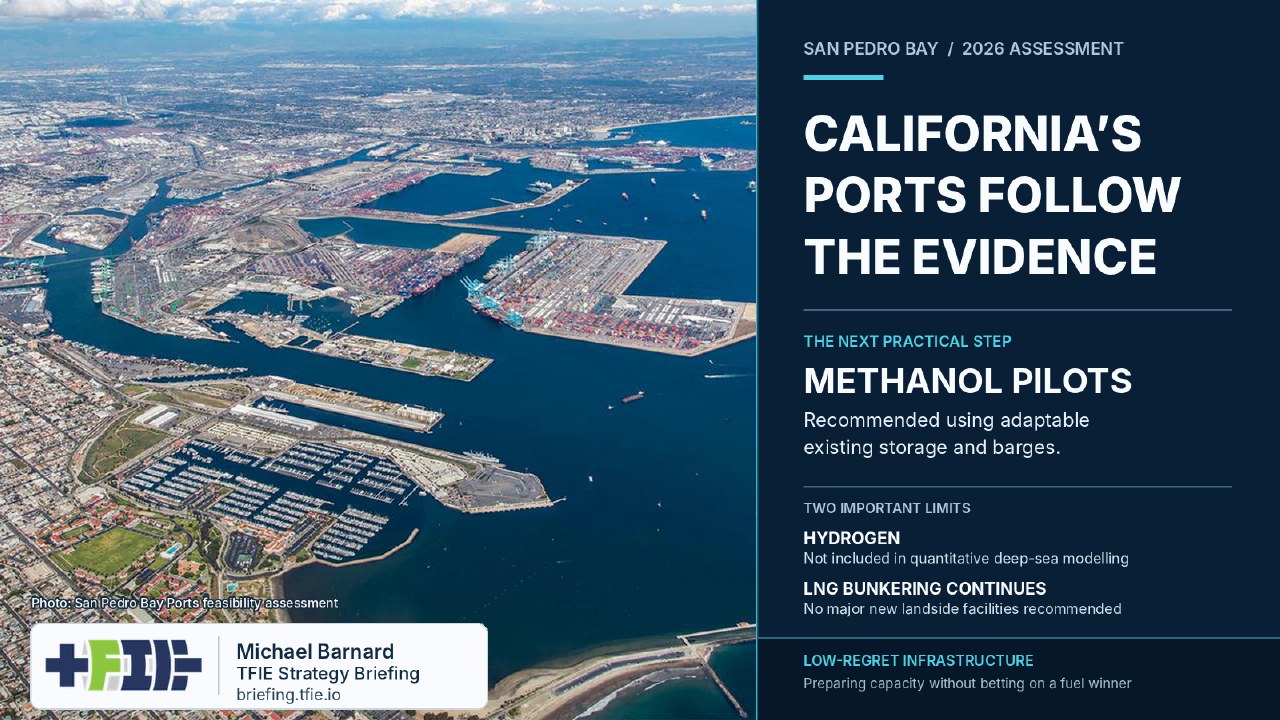
The ports of Los Angeles and Long Beach have published the Clean Marine Fuel Feasibility Assessment, which outlines future fuel strategies for deep-sea shipping. The document excludes hydrogen from detailed quantitative planning, despite California's long-term state-level support for hydrogen technologies in transportation.
The assessment is based on an analysis of shipping fleets, carrier preferences, and infrastructure costs. Of the 38 shipping lines contacted by researchers, 19 provided responses. While nine carriers expressed interest in methanol, only one indicated interest in hydrogen.
The ports recommend prioritizing commercial methanol bunkering demonstrations and maintaining existing ship-to-ship LNG arrangements. Long Beach has already introduced a $1 million incentive to support an initial commercial-scale methanol bunkering operation.
The decision reflects a focus on commercial viability and existing infrastructure. Methanol is considered easier to integrate due to its liquid state and compatibility with established chemical-handling equipment, whereas hydrogen presents challenges related to storage, handling, and energy density.