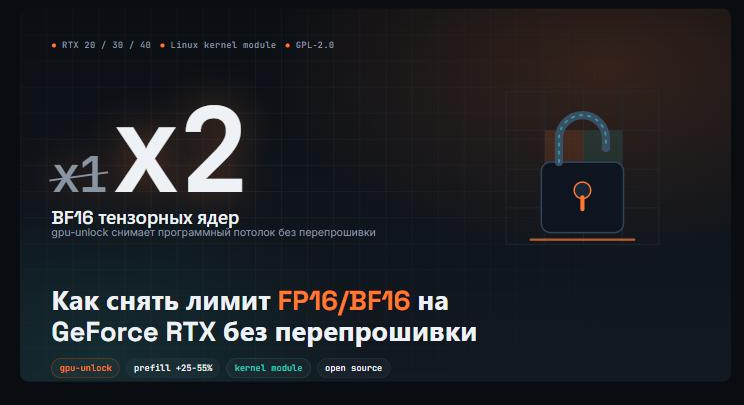
The gpu-unlock project, developed by an individual under the nickname Zagitta, provides a method to remove software-imposed performance limits on NVIDIA graphics cards. The tool operates at the Linux kernel level, eliminating the need for VBIOS flashing or modified drivers.
NVIDIA traditionally restricts the FP16, BF16, and TF32 tensor core performance on its GeForce RTX consumer series compared to professional-grade hardware like Tesla, A100, or H100 cards. These limits often result in the consumer hardware performing at half its potential peak speed.
While these restrictions do not affect gaming performance, they significantly impact tasks such as local LLM inference, model fine-tuning, and image or video generation. These processes rely heavily on the tensor core throughput during training and prefill stages.