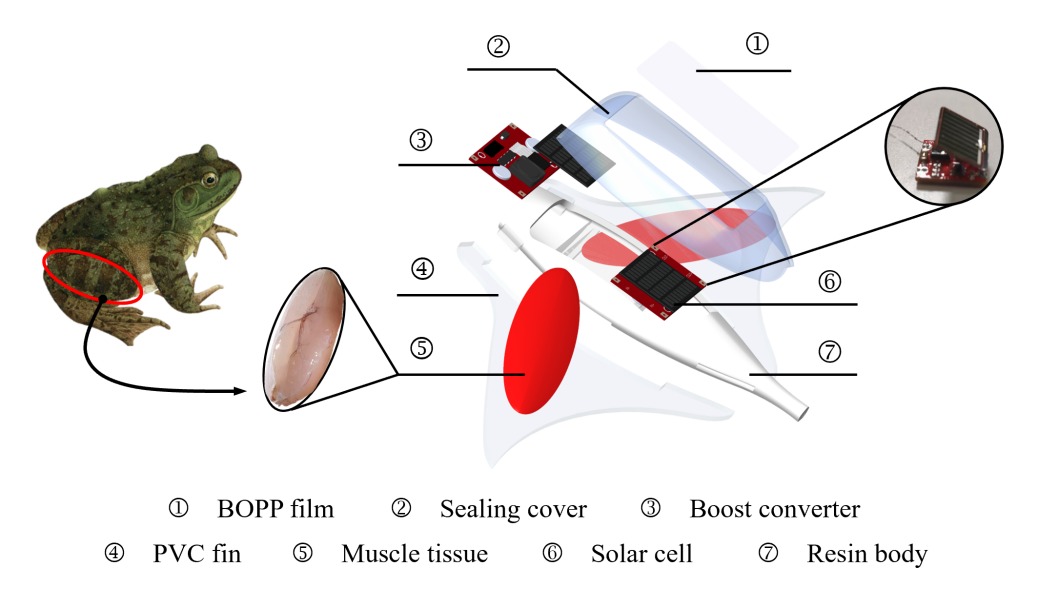
Researchers at the Shenyang Institute of Automation, Chinese Academy of Sciences, have developed a bio-hybrid manta ray robot. The device uses isolated bullfrog skeletal muscle as an actuator, which offers superior contractile performance compared to cell-engineered tissues.
Under optimized electrical stimulation of 1Hz and 5V, the muscle generates 6.5 Newtons of force with a 25% contraction range. The tissue maintains performance for 11 days, allowing the robot to operate for approximately 7 days. Peak force reaches 9.4 Newtons under extreme conditions.
The robot features a wireless near-infrared light control system with gallium arsenide photovoltaic modules. This architecture enables precise underwater maneuvers, including turns and circular paths, without genetic modification of the biological components.
The robot achieves a top speed of 0.54 body lengths per second, with peak bursts reaching 2 body lengths per second. It supports a 5-gram payload underwater and can navigate hard surfaces. The study was published in Advanced Functional Materials.
Future development plans include extending the lifespan of the biological tissue, creating flexible neural-like thin-film electrodes, and integrating onboard energy storage. The project is supported by the National Natural Science Foundation and the Ministry of Science and Technology.