

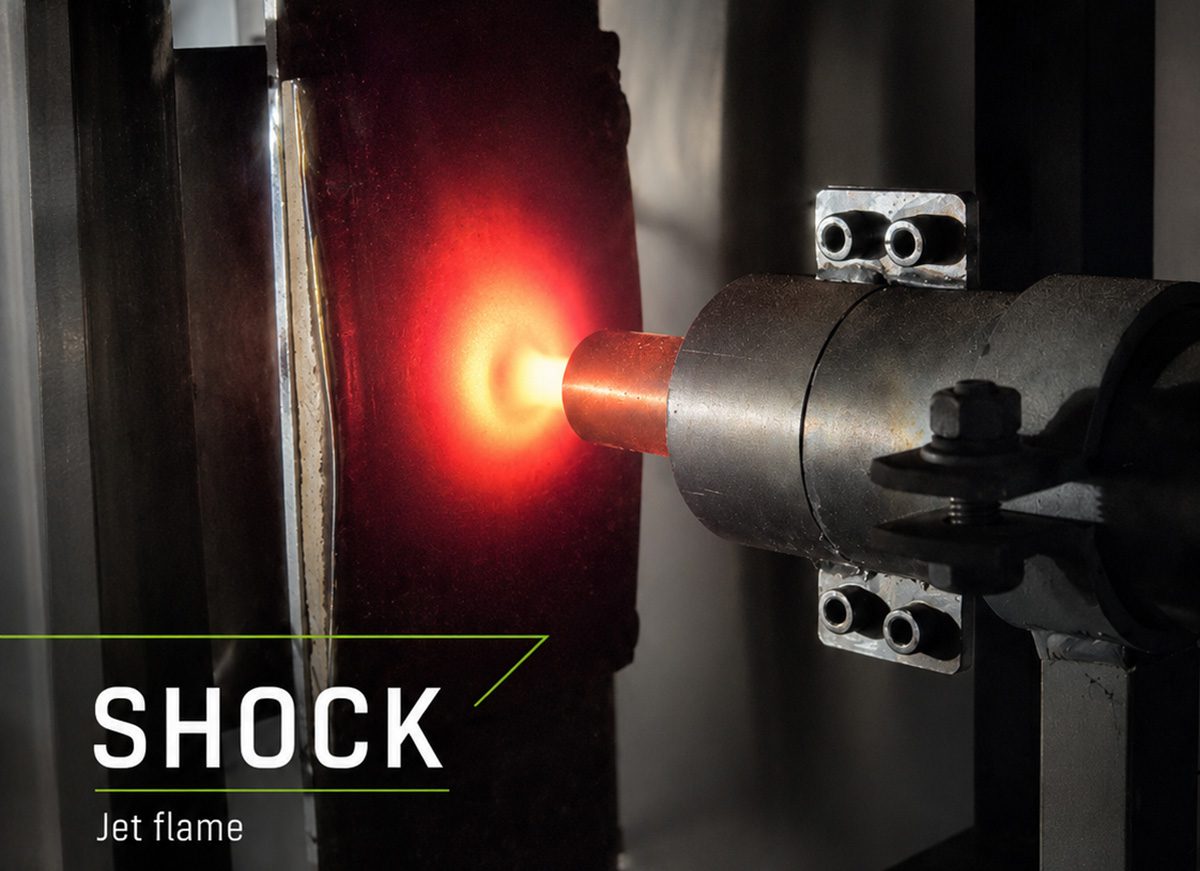
AZL Aachen has commissioned the JetBlast system, designed to test battery casing materials against flame exposure and particle-laden blasts. This setup simulates conditions encountered during cell venting and thermal runaway. The system is part of the Joint Partner Project launched by AZL in 2025, with calibration trials currently underway to ensure repeatability.
The system achieves a maximum test-zone temperature of 1,650 degrees Celsius. During the current benchmark profile, the target temperature reaches 1,300 degrees Celsius before particle blasting, which occurs at approximately 1,250 degrees Celsius. AZL developed a proprietary burner and particle-injection architecture to control flame temperature, particle mass flow, and blast intensity.
JetBlast is the third fire-testing method family introduced by AZL for battery enclosures. It provides detailed data on material integrity, mass loss, and failure modes rather than simple pass-or-fail results. The company notes that this screening tool does not replace standard vehicle-level testing required by regulations such as GB 38031-2025 or UN Regulation No. 100.
The standard project offer includes testing for two material configurations per participant. Companies interested in the program can join until September 2026. According to Ravi Chaitanya Bhairi, Head of Fire Testing for E-Mobility at AZL, the goal is to identify damage-driving loads to optimize material selection and casing architecture for electric vehicle batteries.



