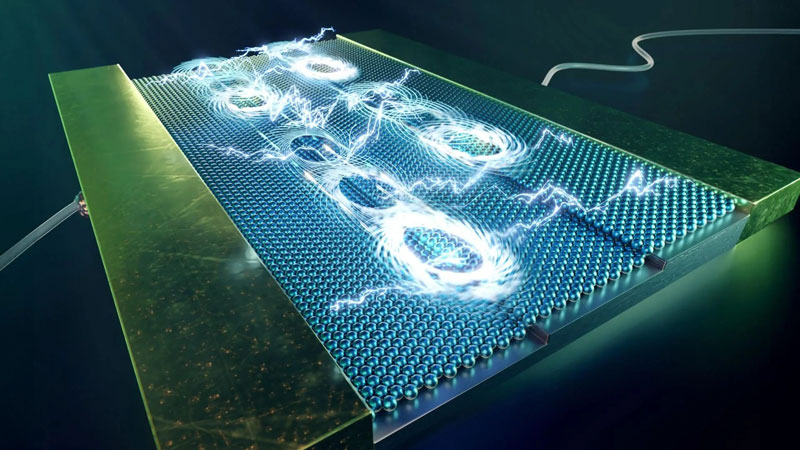
Researchers from the National Institute for Materials Science in Japan have demonstrated a method to control quantum vortices in superconductors using atomic-scale surface features. By utilizing protrusions just one atom high, scientists created paths that guide vortex movement within ultrathin materials.
The study focused on an atomically thin layer of indium on a silicon surface. Observations via scanning tunneling microscopy revealed that these atomic steps act as tracks, allowing vortices to move along them with significantly less resistance compared to movement across the steps.
Experiments showed that vortex mobility along these tracks increases by over 1000 times. This effect is adjustable by modifying external conditions such as temperature or magnetic field strength, which helps overcome energy barriers that typically pin vortices in place.
At magnetic field inductions between 0.10 and 0.20 Tesla, the energy barrier for longitudinal movement drops to near zero, enabling unidirectional flow. At lower temperatures, quantum tunneling also influences vortex behavior, providing new insights for future superconducting electronics.