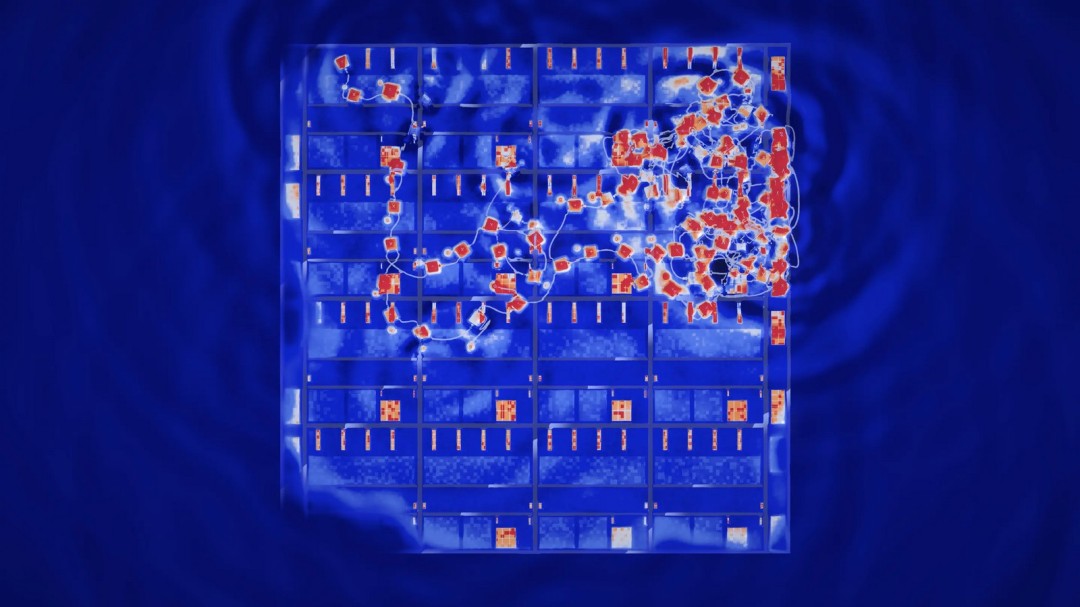
Architect Labs has introduced Frostbite, an experimental CPU architecture designed entirely by AI. The system generated the instruction set, microarchitecture, RTL code, and GDS layout. The design is based on a 1990s mathematical model called interaction nets, which uses a grid of small computing units instead of a single large core.
The architecture operates without a centralized scheduler, allowing units to process tasks locally or share work with neighbors. This approach reduces the need for complex cache hierarchies and shared memory. Programs are written in the Vine language, which resembles Rust, and compiled into an intermediate representation called Ivy.
In simulations using a 7nm process, the Frostbite Quad design achieved a frequency of 500MHz. Compared to a reference CPU core, the architecture demonstrated 4.59 times higher performance per watt across 25 workloads and 8.77 times higher performance per unit area. These results are based on pre-silicon simulations.
The AI development process involved four search rounds and one final test round, evaluating 58 proposals and selecting 37. While the results are promising, the project remains in the experimental phase. Architect Labs has not yet announced plans for mass production or commercial availability of the chips.
Future development plans include releasing the RTL and instruction set architecture, building an FPGA-based testing platform, and developing an operating system. The company intends to perform further benchmarking using industry-standard tools like SPEC and PARSEC to compare Frostbite against larger, out-of-order CPU designs.