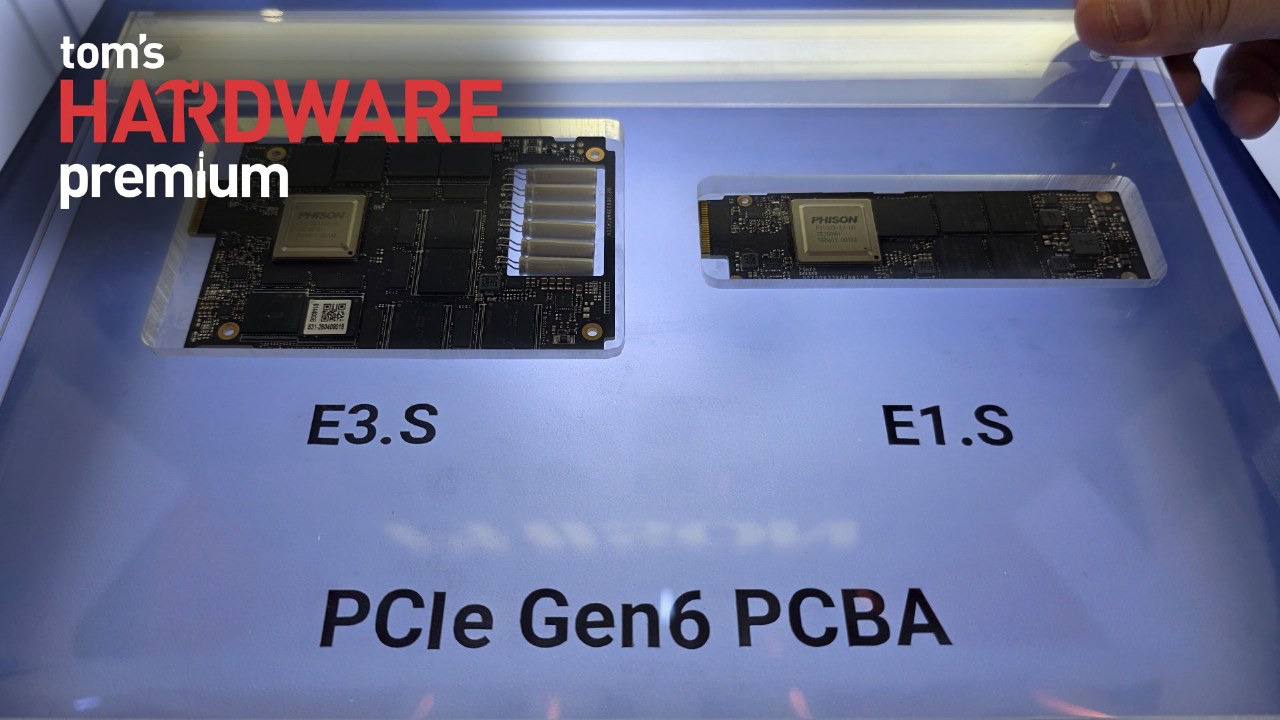
Phison has introduced two new enterprise storage designs. The first is a computational SSD featuring an integrated NPU and 64GB of memory, designed to support AI frameworks like PyTorch and Llama.cpp directly on the drive. This approach aims to reduce data transfer to the host CPU by processing workloads locally.
The second design, known as Mixed Media, combines high-endurance pSLC and high-capacity QLC flash within a single 16-channel SSD. By managing these as separate namespaces, the drive allows the host to direct write-heavy data to the SLC region and read-heavy data to the QLC area, eliminating the need for dedicated cache drives.
Phison claims the computational SSD can deliver 36,800 DMIPS of compute performance. The company suggests that for applicable workloads, this architecture could reduce data transfer by 10 to 100 times. Development on the drive does not require specialized programming tools, as it supports standard inference servers.
The Mixed Media design aims to improve infrastructure efficiency by reducing the number of required drive bays. Phison notes that in a 24-drive system, a single drive failure would result in a 4% cache loss, compared to a 25% loss in systems using dedicated cache drives. The company is also developing the X3 enterprise controller, which targets PCIe 6.0 speeds of up to 28 GB/s.
Phison expects customer samples of the X3 controller by the end of the year, with volume production slated for mid-2026. While competitors like Samsung and Micron are already offering PCIe 6.0 SSDs, Phison continues to explore future PCIe 7.0 standards, which could potentially reach speeds of 50 to 56 GB/s per drive.