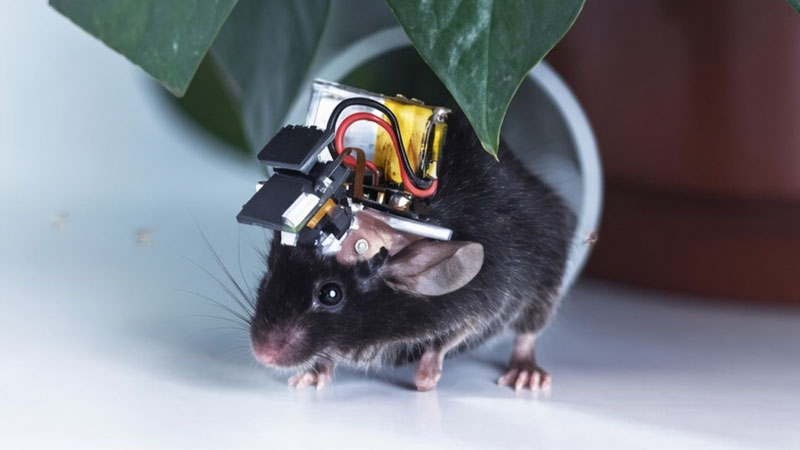
Researchers from Tsinghua University and the Chinese PLA Medical School have developed Airscope, a wireless optical device for monitoring brain activity. The device weighs 1 gram and allows for the observation of over 8,500 neurons in a freely moving mouse.
Airscope is classified as a mesoscope, providing a transverse resolution of 4 micrometers across a 6 mm field of view at a frame rate of 12.5 fps. The system utilizes AI-designed aspherical lenses, which reduced the optical path length by 2.84 times compared to previous miniature microscopes.
The device features LED illumination, fluorescent optics, and a 2-megapixel sensor. Data is stored on an internal memory card, while compressed images are transmitted via Wi-Fi. Researchers also introduced the SAM2Mice system to automatically track animal behavior and movement.
In testing, five mice simultaneously recorded the activity of 21,397 neurons while interacting in complex environments. The data revealed correlations between cortical activity and social competition outcomes, allowing researchers to predict the results of certain interactions.
While the technology has potential applications in human medicine, such as monitoring depression or tissue recovery, clinical trials are not currently planned due to ethical considerations.