

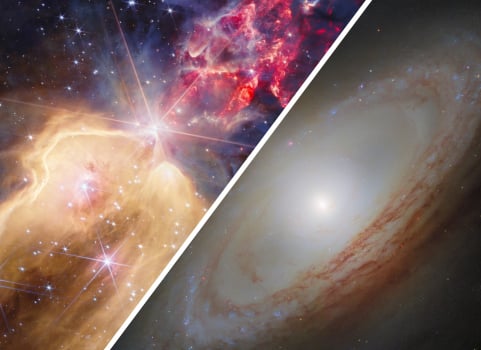
NASA and the European Space Agency, with participation from the Canadian Space Agency for Webb, have released new imagery from the James Webb and Hubble space telescopes. The observations capture various cosmic phenomena, including stellar nurseries, galaxy clusters, and gravitational lensing effects.
Webb observed the stellar nursery NGC 7129, located 3,300 light-years away. The region contains the massive star LkHα 234, which is five to eight times the mass of the Sun. Infrared data revealed hundreds of stars at different evolutionary stages and a 3.5 light-year cavity formed by hydrogen gas outflows.
Hubble studied the spiral galaxy NGC 4698, situated 55 million light-years away in the Virgo constellation. The galaxy features a central bulge rotating perpendicular to its main disk, a phenomenon scientists attribute to external gas influx or a past galactic merger. The center houses a supermassive black hole exceeding a million solar masses.
Webb captured the galaxy cluster MACS J0454.1-0300, showcasing gravitational lensing that magnifies distant galaxies. Some of these lensed objects are seen as they existed 800 million years after the Big Bang. Observations indicate ongoing mergers and intense star formation, with some magnified features appearing 300 times larger.
Hubble examined the LHA 120-N44 nebula in the Large Magellanic Cloud, 160,000 light-years from Earth. The nebula spans 210 by 140 light-years and contains approximately 500,000 stars, including 30,000 young pre-main-sequence stars. The structure was shaped by supernovae that cleared the inner region.



