

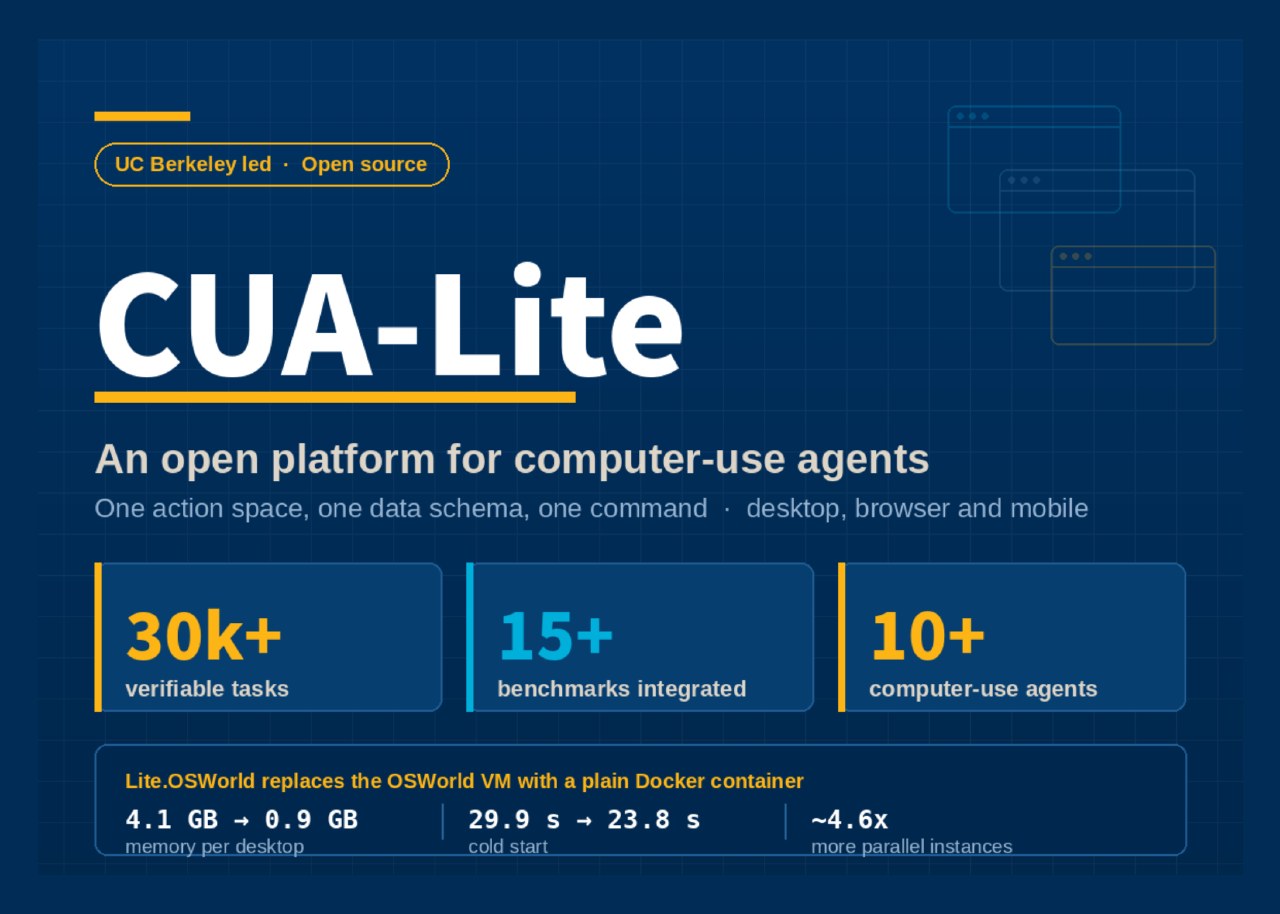
Researchers from UC Berkeley introduced CUA-Lite, an open-source platform designed to unify sandboxes, data, evaluation, and reinforcement learning for computer-use agents. The system runs on Python 3.12 and operates within Docker containers, eliminating the need for nested virtualization required by traditional virtual machines.
The platform includes Lite.OSWorld, which replicates the OSWorld benchmark suite on a GNOME desktop. According to the developers, performance scores across 13 tested models match those of VM-based environments. The ecosystem also features Lite.ScaleCUA, Lite.CUAGym, and Lite.CUAWorld, supporting over 30 000 verifiable tasks across 40 applications like VS Code and Blender.
CUA-Lite utilizes LiteSample, a unified schema for supervised learning that aggregates over 10 existing datasets, including OpenCUA and Multimodal-Mind2Web, available on Hugging Face. The framework includes model-specific adapters that convert data into required training formats, supporting various agent architectures such as GPT, Claude, Gemini, and Qwen3-VL.
The platform integrates more than 15 benchmarks covering desktop, browser, and mobile environments. Users can switch between environments and models by modifying script parameters. The system supports supervised fine-tuning and reinforcement learning, with documented examples of improving Qwen3-VL-2B-Instruct performance on desktop trajectories and GRPO updates for mobile tasks.



