

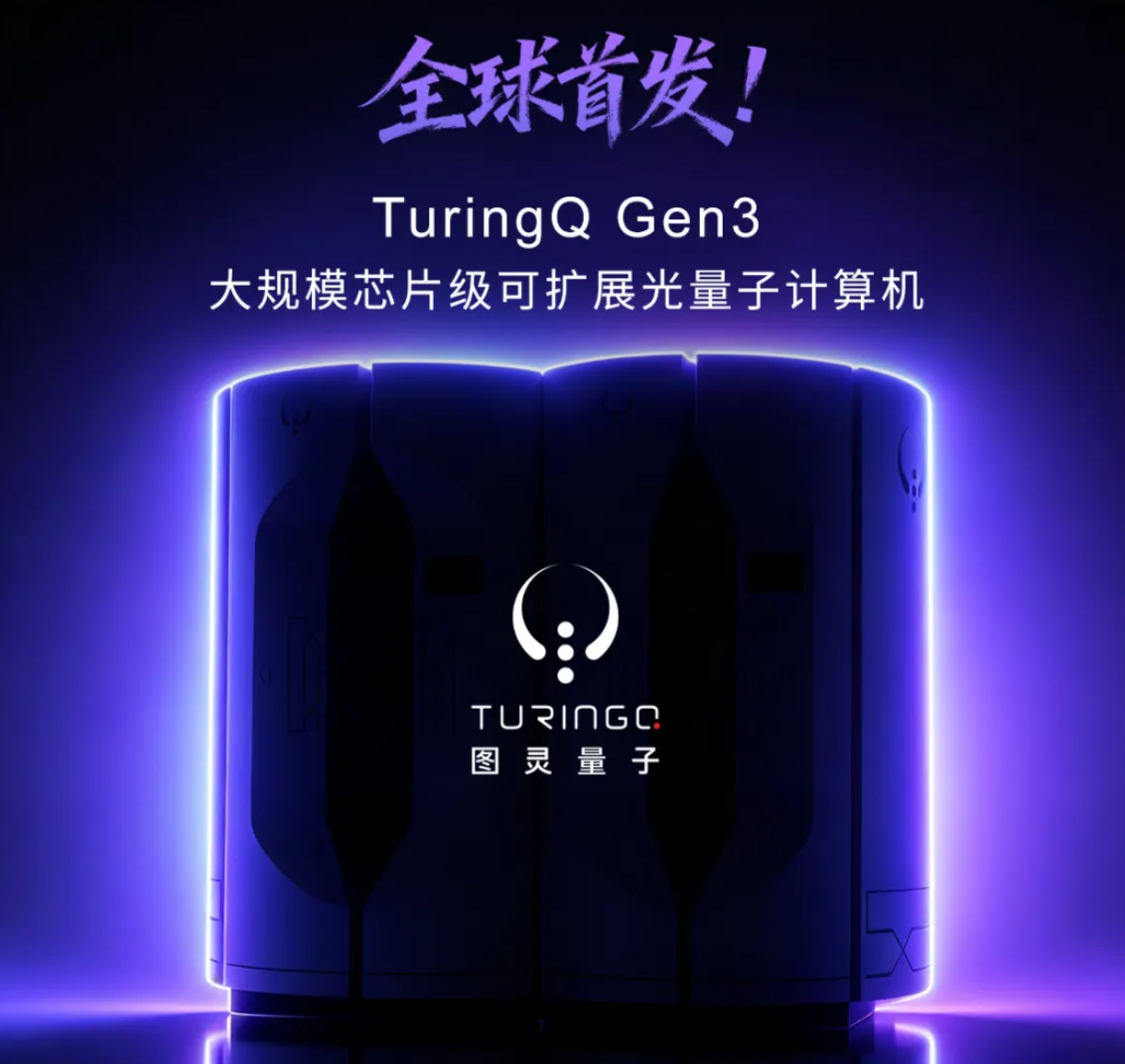
TuringQ has officially unveiled its third-generation optical quantum computer, the TuringQ Gen3. The system is designed in a standard IDC rack form factor and features a fully chip-based, modular, and scalable architecture that allows for on-demand expansion of quantum computing nodes.
The computer is built on high-speed programmable thin-film lithium niobate optical quantum chips. It integrates core modules such as quantum light sources, programmable optical quantum processing chips, single-photon detection, and quantum-classical heterogeneous computing.
The system utilizes a space-time multiplexing architecture that combines spatial optical paths, time loops, and high-speed electro-optic control. This configuration enables the same physical components to participate in quantum evolution across different time modes, supporting expansion up to 10,000 photon-level and 1,000,000 mode-level computing resources.
Technical performance metrics include a photon circuit transmission loss of 0.03 dB/cm and a key single-device insertion loss of less than 0.1 dB. The fiber-to-chip single-end coupling loss is 0.9 dB/facet, while the spectral purity of the wafer-level quantum light source exceeds 99%.
The platform incorporates the proprietary XLink low-latency interconnect architecture. It also includes a suite of quantum-classical hybrid software tools, such as the DeepQuantum programming framework, the Liangqing quantum computing platform, and QAgent, designed to lower development barriers.

