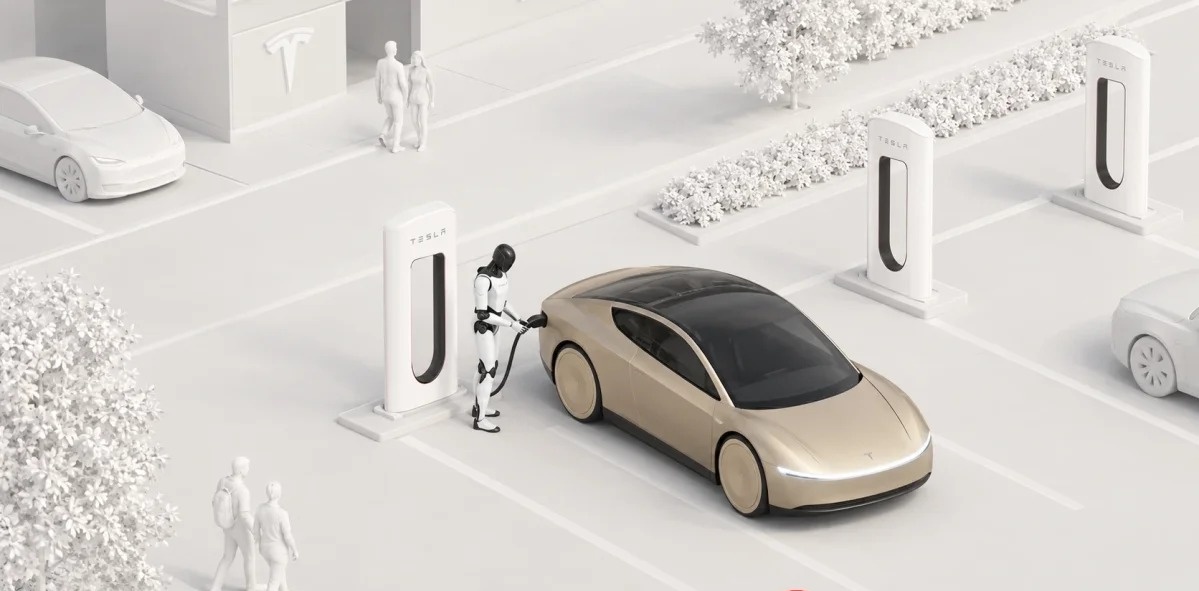
Tesla is currently relying on staff to manually plug in Robotaxi vehicles at supercharger stations. In a recent interview with Munro Live, Tesla Vice President of Vehicle Engineering Lars Moravy and Cybercab project lead Eric Earley confirmed plans to integrate Optimus humanoid robots to handle the charging process as an interim solution.
The Cybercab model currently lacks AC charging support and relies on a NACS port located in the rear bumper. While the company is working on long-term automation, the current infrastructure requires physical connections. Tesla aims to transition toward a wireless charging system, which has already received FCC approval.
The company plans to build a charging hub in Austin equipped with 80 wireless charging units. However, widespread implementation remains a long-term goal. Early production of Optimus robots has begun at the Fremont factory, with the first deliveries to enterprise clients scheduled for 2027.
Beyond charging, Tesla is exploring broader applications for its robotics technology. Executives noted that Optimus could eventually assist with vehicle maintenance and delivery operations. The company views the combination of Cybercab, Optimus, and Robovan as key components of its physical artificial intelligence strategy.