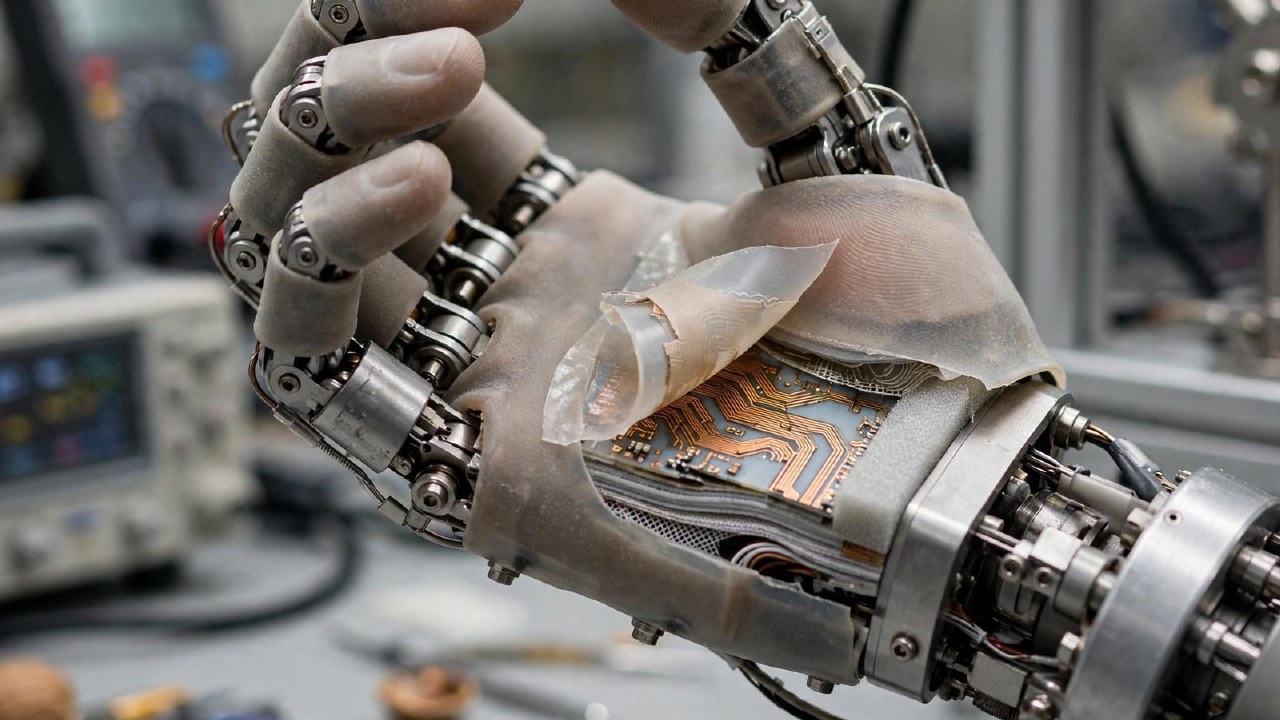
Tesla has filed a patent application in the United States for a flexible tactile surface technology designed for robotic hands. The filing, identified as US 2026/0310299 A1, details a manufacturing process that allows sensors to be applied to a flat flexible material before it is molded into a three-dimensional shape. This approach is intended for use on fingertips, palms, and other manipulator components.
The sensor structure consists of two flexible layers with conductive regions separated by a compressible material. When pressure is applied, the structure deforms, altering electrical properties that allow the system to detect contact. The patent specifies two measurement principles: capacitive and piezoresistive. Materials listed for the sensor base include thermoplastic polyurethane, polyethylene terephthalate, and polyimide.
The manufacturing process described in the application involves screen printing, laser cutting, conductive paste application, and thermoforming. These techniques enable the creation of sensitive surfaces that conform to the curves of a robotic hand, eliminating the need for individual rigid sensor components. The technology is designed to measure contact force, touch, and pressure.
The patent application does not confirm the integration of this technology into the Tesla Optimus humanoid robot. Furthermore, the document lacks quantitative data regarding sensor sensitivity, spatial resolution, or service life. Consequently, it is currently impossible to assess the operational accuracy or reliability of this tactile skin in real-world conditions.