

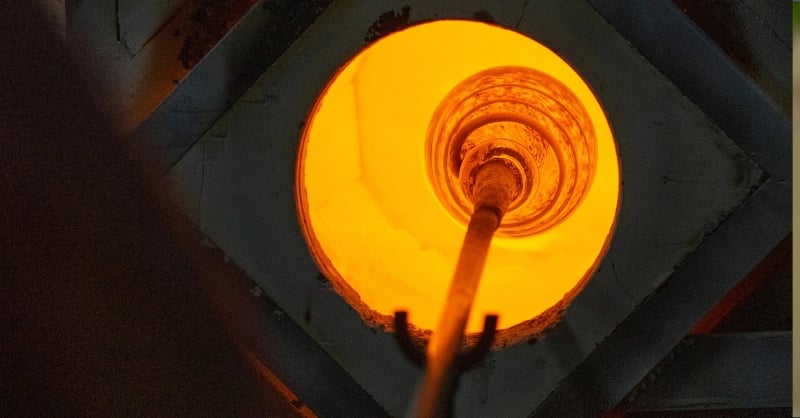
Optical fibre production begins with a preform, a thick glass cylinder that is drawn into a strand with a diameter of approximately 125 micrometers. The manufacturing process involves several specialized stages, including chemical delivery, deposition, consolidation, and drawing.
Preform fabrication methods include modified chemical vapour deposition (MCVD), outside vapor deposition, and vapour axial deposition. These processes rely on precise control of gas flow, temperature, and mechanical movement to form the core and cladding layers.
During the consolidation phase, a porous soot body is transformed into dense, clear glass within a furnace. This stage requires strict environmental control to prevent contamination and ensure uniform heating, which is verified by refractive index analysers.
The draw tower is used to stretch the preform into a thin fibre. Laser gauges monitor the diameter in real time, while load sensors manage tension. Coating applicators then apply two layers of polymer to protect the glass, which are subsequently cured using UV lamps.
Final quality assurance involves proof testing under controlled tension to identify weak points. Optical tests measure signal attenuation, while geometry instruments verify the core position, cladding shape, and concentricity of the finished product.


